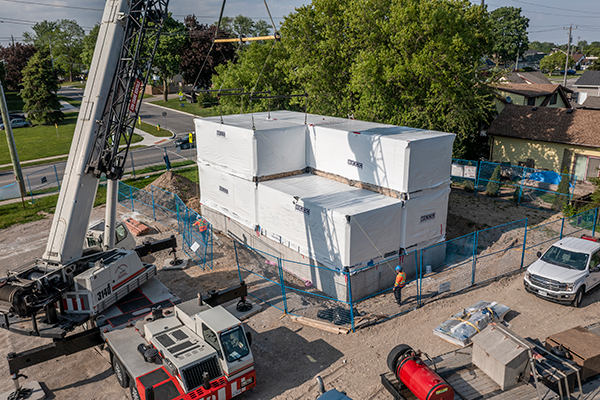
In the bustling realm of Ontario’s housing market, modular construction is emerging as a beacon of hope amid a pressing demand for new homes. However, as Albert Bendersky, vice-president of design at Hamilton’s BECC Modular Solutions, points out, several barriers must be dismantled to fully harness this innovative construction method.
Chief among these obstacles is the absence of formal pre-approval or recognition by provincial and municipal authorities for standardized modular units. The existing building code, described as inflexible, does not yet accommodate the revolutionary technologies that modular construction could bring to the fore.
In an effort to bridge these understanding gaps, BECC recently hosted a group of planners at its facility, coinciding with the annual Ontario Professional Planners Institute conference. During this event, Bendersky emphasized the potential of modular construction to meet various municipal and aesthetic requirements, stating, “We can achieve the same results that have been achieved before,” advocating for a shift towards new technological solutions in the sector.
BECC — An executive with BECC modular solutions recently explained that non-modular areas of a manufactured home typically include foundations, structural cores such as staircases and elevator shafts, and large open public zones with flexible use areas. Often it is easier to leave the ground floor fully traditional.
The essence of resolving the housing crisis, Bendersky asserts, lies in the mass-production of high-quality buildings. This involves integrating 21st-century industrial technologies akin to those used in automobile and electronics manufacturing. BECC, for instance, leverages Hamilton’s high-grade steel as a key component in their process, although other materials like wood or concrete are also viable.
The manufacturing process at BECC begins with pre-cut and pre-drilled steel parts, assembling modules complete with wiring, piping, insulation, and more. This modular approach aims to significantly reduce time and costs, paralleling modern industrial efficiency.
Bendersky highlighted a current project for a California client to illustrate the efficiency of modular construction when supported by an effective approvals system. Unlike Ontario’s layered planning and political processes, California’s system allows for streamlined approvals, enabling projects to proceed without repetitive bureaucratic hurdles.
To truly enhance the adoption of modular construction in Ontario, Bendersky suggests the development of a pre-approval system by large municipalities. Such a system would expedite projects by alleviating some of the red tape associated with building permits, especially for small to mid-size developments.
The integration of new technologies into the building code is essential, as existing codes hinder progress by not recognizing the capabilities of modern construction methods, Bendersky explained.
In conclusion, BECC is on the cusp of further technological advancement with plans to introduce robotic systems, poised to enhance manufacturing speed and efficiency. As the industry becomes more sophisticated, sustainable construction standards like Passive Haus and net-zero should become achievable goals, mirroring traditional building achievements.
Despite these challenges, the sector is advancing rapidly with the help of Building Information Modelling (BIM) platforms and AI tools, enabling a more scientific approach to construction. Follow Don Wall on X/Twitter for ongoing updates in this rapidly evolving field.
More Articles
Getting licensed or staying ahead in your career can be a journey—but it doesn’t have to be overwhelming. Grab your favorite coffee or tea, take a moment to relax, and browse through our articles. Whether you’re just starting out or renewing your expertise, we’ve got tips, insights, and advice to keep you moving forward. Here’s to your success—one sip and one step at a time!
Despite billions poured into proptech and a decade of flashy digital upgrades, the real estate experience remains largely unchanged. Apps made processes smoother, but not more transparent — because the industry’s core structures, data control and power dynamics stayed the same. True disruption will come from platforms that shift information and control to consumers, not just digitize outdated systems.
Early 2026 is delivering a clear message: commercial real estate is entering a recalibration phase. Construction is softening, pending home sales just saw a sharp drop, consumer sentiment is inching upward but remains fragile, and capital markets are tightening as major CRE sectors face rising distress. From data centers powering ahead to CMBS foreclosures climbing and office-to-residential conversions gaining momentum, professionals across real estate, mortgage, insurance, and finance need to stay sharp as the industry shifts.
Discover the real estate roles earning the biggest paychecks in 2026. From investment consultants to commercial leasing managers, this breakdown highlights the salaries, responsibilities, and career paths offering the strongest financial potential in today’s evolving market—perfect for newcomers and seasoned professionals mapping their next big move.
Montana is taking major steps to remove outdated licensing barriers and strengthen its workforce. Governor Greg Gianforte has created a new Licensing Reform Task Force aimed at modernizing regulations, speeding up approvals, and helping more professionals enter high‑demand fields like construction and healthcare. With licensing numbers doubling over the past decade and rural communities facing critical shortages, the state is pushing for faster, more efficient pathways to work. The task force begins meeting in February and will deliver its full reform report by September 2026 — a move that could influence licensing modernization efforts nationwide.
Artificial intelligence has officially moved from novelty to necessity in the real estate world. According to new industry data, 97% of brokerage leaders say their agents now rely on AI tools for everything from listing descriptions to full-scale marketing campaigns. As adoption skyrockets, so do concerns over training, accuracy, and compliance — especially among smaller firms. The message is clear: for today’s real estate professionals, AI literacy isn’t optional anymore.
Commercial real estate roared back to life in 2025, with more than $255B pouring into multifamily, industrial, office and retail assets. Major investors moved fast on falling interest rates, improving bond yields and rising confidence across sectors. Multifamily dominated with over $115B in deals, industrial surged under private equity leadership, office saw renewed activity from owner-users and retail proved surprisingly resilient. For today’s real estate and finance professionals, the message is clear: opportunity favors those who stay informed and ready to act.