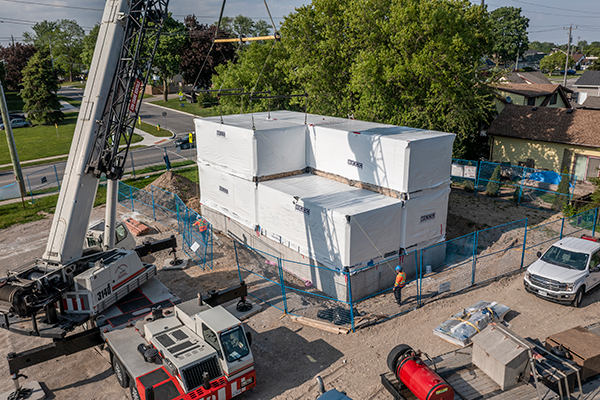
In the bustling realm of Ontario’s housing market, modular construction is emerging as a beacon of hope amid a pressing demand for new homes. However, as Albert Bendersky, vice-president of design at Hamilton’s BECC Modular Solutions, points out, several barriers must be dismantled to fully harness this innovative construction method.
Chief among these obstacles is the absence of formal pre-approval or recognition by provincial and municipal authorities for standardized modular units. The existing building code, described as inflexible, does not yet accommodate the revolutionary technologies that modular construction could bring to the fore.
In an effort to bridge these understanding gaps, BECC recently hosted a group of planners at its facility, coinciding with the annual Ontario Professional Planners Institute conference. During this event, Bendersky emphasized the potential of modular construction to meet various municipal and aesthetic requirements, stating, “We can achieve the same results that have been achieved before,” advocating for a shift towards new technological solutions in the sector.
BECC — An executive with BECC modular solutions recently explained that non-modular areas of a manufactured home typically include foundations, structural cores such as staircases and elevator shafts, and large open public zones with flexible use areas. Often it is easier to leave the ground floor fully traditional.
The essence of resolving the housing crisis, Bendersky asserts, lies in the mass-production of high-quality buildings. This involves integrating 21st-century industrial technologies akin to those used in automobile and electronics manufacturing. BECC, for instance, leverages Hamilton’s high-grade steel as a key component in their process, although other materials like wood or concrete are also viable.
The manufacturing process at BECC begins with pre-cut and pre-drilled steel parts, assembling modules complete with wiring, piping, insulation, and more. This modular approach aims to significantly reduce time and costs, paralleling modern industrial efficiency.
Bendersky highlighted a current project for a California client to illustrate the efficiency of modular construction when supported by an effective approvals system. Unlike Ontario’s layered planning and political processes, California’s system allows for streamlined approvals, enabling projects to proceed without repetitive bureaucratic hurdles.
To truly enhance the adoption of modular construction in Ontario, Bendersky suggests the development of a pre-approval system by large municipalities. Such a system would expedite projects by alleviating some of the red tape associated with building permits, especially for small to mid-size developments.
The integration of new technologies into the building code is essential, as existing codes hinder progress by not recognizing the capabilities of modern construction methods, Bendersky explained.
In conclusion, BECC is on the cusp of further technological advancement with plans to introduce robotic systems, poised to enhance manufacturing speed and efficiency. As the industry becomes more sophisticated, sustainable construction standards like Passive Haus and net-zero should become achievable goals, mirroring traditional building achievements.
Despite these challenges, the sector is advancing rapidly with the help of Building Information Modelling (BIM) platforms and AI tools, enabling a more scientific approach to construction. Follow Don Wall on X/Twitter for ongoing updates in this rapidly evolving field.
More Articles
Getting licensed or staying ahead in your career can be a journey—but it doesn’t have to be overwhelming. Grab your favorite coffee or tea, take a moment to relax, and browse through our articles. Whether you’re just starting out or renewing your expertise, we’ve got tips, insights, and advice to keep you moving forward. Here’s to your success—one sip and one step at a time!
Data from 2023 forecasts a potential "Multifamily Real Estate Decline 2024" due to rising cap rates and slowed NOI. However, resources from Cameron Academy help real estate professionals navigate "Investment Risks in Multifamily Properties" through real-time, accurate insights.
Investing in real estate can be rewarding but finding the right financing can be challenging. One popular option is the BRRRR (Buy, Rehab, Rent, Refinance, Repeat) method, which involves purchasing distressed properties, renovating them, renting them out, and then refinancing to repeat the process. Traditional banks, private money lenders, portfolio lenders, and online lending platforms are all potential sources for BRRRR loans. Another financing option to consider is the DSCR (Debt Service Coverage Ratio) loan, which assesses the property's cash flow rather than just the borrower's income. DSCR loans are commonly used in commercial real estate investments and offer advantages like better cash flow assessment and flexibility for investors. However, they also come with drawbacks such as higher interest rates and stricter qualification requirements. Choosing the right financing option depends on investment strategy, financial considerations, qualification requirements, risk profile, and expert advice. By understanding the available options and considering individual circumstances, investors can select the financing option that aligns with their goals.
In this blog excerpt, we discuss the forecast for catastrophic declines in the multifamily market by the end of 2024. Factors such as market saturation, economic uncertainty, and changing lifestyle preferences among renters contribute to this forecast. Potential risks for investors include oversupply, economic volatility, and shifts in tenant demand. Thorough research, analysis, and seeking advice from professionals are crucial for navigating the multifamily market. Being knowledgeable and making informed decisions are key to successful investments in real estate. To get started in the industry, visit CameronAcademy.com for licensing in Real Estate, Mortgage, Insurance, or Finance.
In the world of mortgages, the debate between fixed rate and adjustable rate mortgages (FRM and ARM) rages on. FRMs provide consistency and protection against rising rates, while ARMs offer lower initial rates and flexibility. When choosing between the two, factors such as financial goals, economic conditions, time horizon, and risk tolerance must be considered. Ultimately, homeowners must weigh the pros and cons and seek professional advice before making a decision. After all, the right mortgage choice can have a lasting impact on one's financial well-being.
Navigating the complexities of the current housing market can be a daunting task for buyers and sellers alike. Affordability concerns, limited inventory, credit tightening, rising interest rates, and firming home prices are all factors contributing to the challenges in today's market. However, by conducting thorough research, partnering with knowledgeable real estate agents, planning for your budget and mortgage, seeking out alternative financing options, and being patient and flexible, you can overcome these obstacles. With perseverance, informed decision-making, and adaptability, success in real estate transactions can be achieved in any market environment.