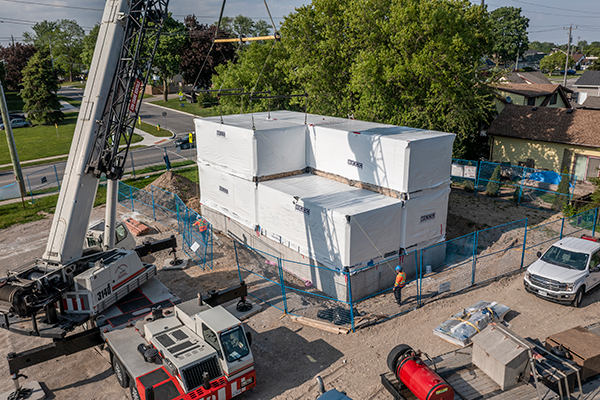
In the bustling realm of Ontario’s housing market, modular construction is emerging as a beacon of hope amid a pressing demand for new homes. However, as Albert Bendersky, vice-president of design at Hamilton’s BECC Modular Solutions, points out, several barriers must be dismantled to fully harness this innovative construction method.
Chief among these obstacles is the absence of formal pre-approval or recognition by provincial and municipal authorities for standardized modular units. The existing building code, described as inflexible, does not yet accommodate the revolutionary technologies that modular construction could bring to the fore.
In an effort to bridge these understanding gaps, BECC recently hosted a group of planners at its facility, coinciding with the annual Ontario Professional Planners Institute conference. During this event, Bendersky emphasized the potential of modular construction to meet various municipal and aesthetic requirements, stating, “We can achieve the same results that have been achieved before,” advocating for a shift towards new technological solutions in the sector.
BECC — An executive with BECC modular solutions recently explained that non-modular areas of a manufactured home typically include foundations, structural cores such as staircases and elevator shafts, and large open public zones with flexible use areas. Often it is easier to leave the ground floor fully traditional.
The essence of resolving the housing crisis, Bendersky asserts, lies in the mass-production of high-quality buildings. This involves integrating 21st-century industrial technologies akin to those used in automobile and electronics manufacturing. BECC, for instance, leverages Hamilton’s high-grade steel as a key component in their process, although other materials like wood or concrete are also viable.
The manufacturing process at BECC begins with pre-cut and pre-drilled steel parts, assembling modules complete with wiring, piping, insulation, and more. This modular approach aims to significantly reduce time and costs, paralleling modern industrial efficiency.
Bendersky highlighted a current project for a California client to illustrate the efficiency of modular construction when supported by an effective approvals system. Unlike Ontario’s layered planning and political processes, California’s system allows for streamlined approvals, enabling projects to proceed without repetitive bureaucratic hurdles.
To truly enhance the adoption of modular construction in Ontario, Bendersky suggests the development of a pre-approval system by large municipalities. Such a system would expedite projects by alleviating some of the red tape associated with building permits, especially for small to mid-size developments.
The integration of new technologies into the building code is essential, as existing codes hinder progress by not recognizing the capabilities of modern construction methods, Bendersky explained.
In conclusion, BECC is on the cusp of further technological advancement with plans to introduce robotic systems, poised to enhance manufacturing speed and efficiency. As the industry becomes more sophisticated, sustainable construction standards like Passive Haus and net-zero should become achievable goals, mirroring traditional building achievements.
Despite these challenges, the sector is advancing rapidly with the help of Building Information Modelling (BIM) platforms and AI tools, enabling a more scientific approach to construction. Follow Don Wall on X/Twitter for ongoing updates in this rapidly evolving field.
More Articles
Getting licensed or staying ahead in your career can be a journey—but it doesn’t have to be overwhelming. Grab your favorite coffee or tea, take a moment to relax, and browse through our articles. Whether you’re just starting out or renewing your expertise, we’ve got tips, insights, and advice to keep you moving forward. Here’s to your success—one sip and one step at a time!
After years of soaring premiums and insurer instability, Florida’s property insurance market is finally turning a corner. Major carriers have filed 83 requests for rate decreases heading into 2026, with companies like Florida Peninsula and Patriot Select proposing cuts of 8.4% and 11.3%. Some homeowners may see relief as early as next month, signaling a long‑awaited shift toward market stability.
Fix-and-flip investing is gearing up for one of its strongest years in a decade as 2026 approaches. With cheaper capital, more accessible funding, easing interest rates, and long-awaited increases in housing inventory, investors are finding the perfect environment to launch or scale renovation-based real estate businesses. Renovation continues to outpace new construction in cost and speed, and demand for move-in-ready homes remains high, making 2026 a powerful opportunity window for both new and experienced investors.
After a short-lived period of relief in 2025, the U.S. rental market may be headed for a tighter, more expensive 2026. With construction starts dropping nearly 11% and completions plunging 42%, the surge of new apartments that helped lower rents is rapidly drying up. Rising costs, shrinking inventory, and a slowdown in new development point to a potential rental crunch that could leave renters facing heavier competition and higher prices across major markets next year.
The commercial real estate market is entering a rare reset that experts say mirrors the post‑2008 boom, creating a potential window for disciplined investors. With trillions in commercial debt coming due and property values dropping up to 40%, firms like AARE are positioning themselves to acquire assets below replacement cost—an advantage that could set the stage for significant long‑term growth.
Commercial real estate is entering a reinvention phase, with AI‑driven productivity, modernized office demand, experience‑focused retail, expanding industrial logistics, creative housing solutions, and sustainability‑centered design all accelerating nationwide. These six forces are shaping how investors, brokers, and future licensees will operate in a rapidly evolving U.S. market.
After years of economic uncertainty and cautious decision‑making, 2026 is shaping up to be the year professionals finally catch a break. AI is moving from buzzword to essential tool, capital markets are beginning to thaw, and hiring is picking up across real estate, mortgage, insurance, finance, and healthcare. With opportunity returning, many professionals are using this moment to upskill—pursuing new licenses, certifications, and cross‑industry expertise.