As the digital landscape continues to evolve, businesses are increasingly turning to artificial intelligence (AI) technologies to enhance their operations and drive financial growth. According to a report by Frost & Sullivan, a staggering 89% of organizations believe that AI and machine learning will be instrumental in boosting revenue, improving operational efficiency, and enhancing customer experiences.
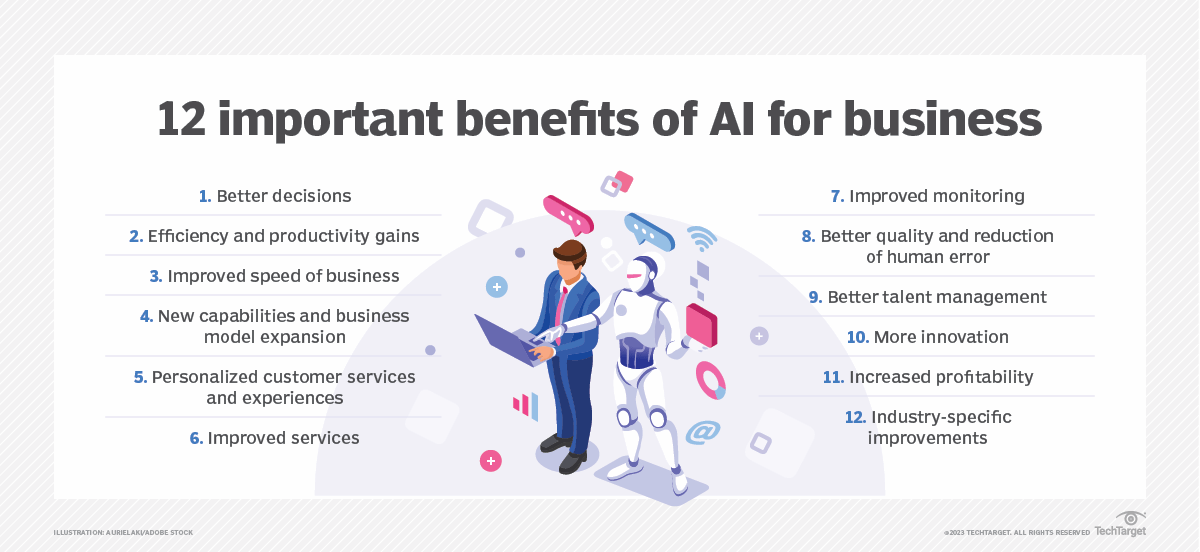
In an in-depth exploration by Mary K. Pratt, featured on TechTarget, the article titled “12 Key Benefits of AI for Business” delves into the myriad ways AI is transforming industries. Here are some of the standout benefits:
1. Better Decisions
AI empowers organizations to make more informed, data-driven decisions. By analyzing vast amounts of data, AI helps eliminate bias and personal preferences, leading to more accurate outcomes.
2. Efficiency and Productivity Gains
AI enables businesses to handle tasks at unprecedented volumes and speeds, freeing up human resources for higher-level tasks. This translates to significant productivity gains and cost reductions.
3. Improved Speed of Business
With AI, businesses can accelerate processes, from design to commercialization, resulting in shorter cycles and measurable returns on investment.
4. New Capabilities and Business Model Expansion
AI opens new avenues for business model expansion. For instance, autonomous vehicle companies can leverage data for new revenue streams, while insurance firms can explore fleet management opportunities.
5. Personalized Customer Services and Experiences
AI’s ability to analyze consumer data allows for highly personalized services, enhancing customer satisfaction across sectors from retail to healthcare.
6. Improved Services
AI facilitates more intuitive and accurate interactions with technology, enhancing user experiences in various industries, including real estate and customer service.
7. Improved Monitoring
Real-time data processing by AI allows for near-instantaneous monitoring, alerting organizations to issues and recommending actions, especially in manufacturing and cybersecurity.
8. Better Quality and Reduction of Human Error
AI reduces errors and improves adherence to standards, particularly when combined with robotic process automation, enhancing the value proposition for businesses.
9. Better Talent Management
AI streamlines hiring processes, eliminates bias, and enhances workforce productivity by identifying top-tier candidates and providing personalized employee experiences.
10. More Innovation
As familiarity with AI grows, employees use it to foster creativity and innovation, from crafting personalized cocktails in restaurants to supporting R&D in healthcare.
11. Increased Profitability
Through enhanced productivity and new growth opportunities, AI contributes to increased profitability, with its potential for revenue growth being exponential.
12. Industry-Specific Improvements
Retail: AI optimizes marketing, supply chain, and pricing strategies.
Pharmaceuticals: AI aids in drug discovery and data analysis.
Finance: AI enhances risk management and fraud detection.
While the benefits of AI are substantial, organizations must also navigate challenges such as AI bias, regulatory concerns, and talent shortages. As businesses continue to integrate AI, they must ensure the necessary infrastructure and skills are in place to fully realize its potential.
For more insights, visit the original article on TechTarget.
More Articles
Getting licensed or staying ahead in your career can be a journey—but it doesn’t have to be overwhelming. Grab your favorite coffee or tea, take a moment to relax, and browse through our articles. Whether you’re just starting out or renewing your expertise, we’ve got tips, insights, and advice to keep you moving forward. Here’s to your success—one sip and one step at a time!
Cameron Academy is thrilled to offer the Free Annual Florida Real Estate Sales Associate 63-Hour Pre-License Course Livestream. This exclusive event is an opportunity for aspiring real estate professionals to gain expert instruction, access a comprehensive curriculum, and connect with a network of professionals in the industry. The course will be livestreamed from December 04-15, 2023, allowing you to participate from the comfort of your own home or office. Register now to secure your spot in this highly sought-after course. Spaces are limited, so early registration is highly recommended. Take the first step towards your real estate career today!
Coldwell Banker, a renowned real estate brand, has recently appointed Jason Waugh as the new president of Coldwell Banker Affiliates. In his new role, Waugh will be responsible for overseeing the brand's strategy, operations, and sales for its growing network of franchises. This appointment comes as Coldwell Banker aims to further strengthen its position in the real estate market. With an impressive background in the industry, Waugh brings a wealth of experience to his new position. Previously associated with Berkshire Hathaway HomeServices and Berkshire Hathaway Home Services Real Estate Professionals for 18 years, Waugh's expertise and leadership qualities make him an ideal fit for this role.
United Wholesale Mortgage (UWM), the country's leading lender, has increased its agency conforming loan limits to $750,000. This move, ahead of the Federal Housing Finance Agency's expected decision, applies to conventional and VA loans locked from October 11. The decision offers borrowers greater flexibility and access to larger loan amounts, with the benefits of conforming loans. These loans meet the guidelines set by government-sponsored enterprises like Fannie Mae and Freddie Mac, offering lower interest rates and more favorable terms compared to non-conforming or jumbo loans.
PNC Bank has implemented a cost-cutting strategy, leading to layoffs and a shift in focus towards expense management and strategic priorities. The bank aims to streamline operations, improve efficiency, and reallocate resources to align with long-term goals. Despite the layoffs, PNC Bank is committed to supporting affected employees during the transition period. Learn more about PNC Bank's strategy and its impact on the industry at Cameron Academy, a leading career education school.
Government-sponsored enterprise (GSE) loan buybacks have emerged as a significant issue for lenders in the mortgage market. The sudden increase in buybacks from entities like Fannie Mae and Freddie Mac is causing financial and operational strain among lenders. The rise in loan buybacks is largely due to stricter underwriting guidelines enforced by these GSEs. The impact of these buybacks is significant and far-reaching. Lenders not only face financial losses from repurchasing loans, but they also encounter operational challenges. The surge in loan buybacks has created uncertainty in the mortgage market, potentially slowing down the housing market. In response to the challenges posed by loan buybacks, lenders are implementing stricter underwriting practices and enhancing their quality control processes.
The housing market is currently witnessing an unusual trend - a deceleration in the growth of housing inventory, despite the rise in mortgage rates. This unexpected development has triggered concerns among potential buyers and industry experts. With mortgage rates climbing from their historic lows, the number of homes available for sale remains surprisingly stagnant. We investigate the factors contributing to this unexpected stagnation in inventory growth and examine the implications of rising mortgage rates, limited new listings, and an increase in price cuts. We also consider the impact of external elements such as labor reports and geopolitical risks on the housing market.