Auction.com has unveiled its 2025 Distressed Market Outlook, projecting a potential 8% decrease in foreclosure auction volume for the upcoming year. This baseline scenario is complemented by two alternative forecasts which could see an increase in auction volumes based on differing economic conditions.
Jason Allnutt, CEO at Auction.com, highlighted the importance of their platform, stating, “The Auction.com marketplace provides rich, real-time data on supply, demand, and pricing for distressed properties sold at auction nationwide.” This data is crucial for forecasting trends in the retail housing market.
The report indicates that foreclosure auction volumes are set to hit a three-year low in 2024. This decline is attributed to increased market headwinds, such as rising retail inventory and persistently high mortgage rates, which have impacted local community developers.
Auction buyers have shown a decreased willingness to pay prices relative to the after-repair value of properties towards the end of 2024. However, signs of recovery were evident in November and December, as price demands began to climb.
Foreclosure Auction Supply
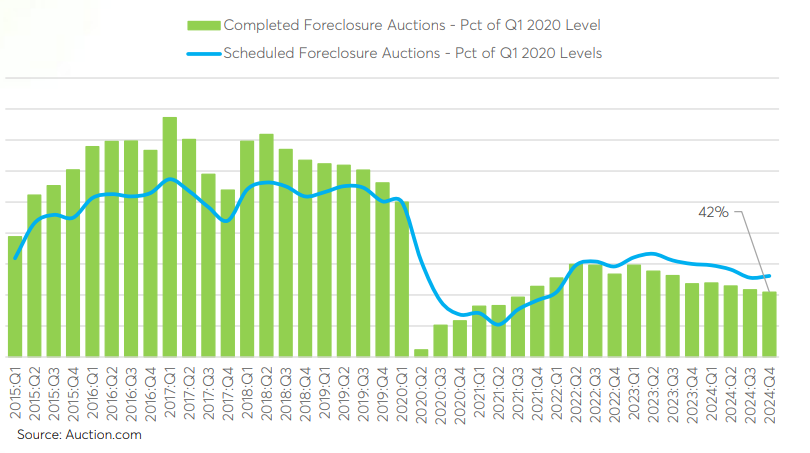
Completed foreclosure auction volume in Q4 of 2024 decreased by 3% from Q3 and was down 11% from the previous year, reaching its lowest since Q3 of 2021. Auction.com data, which represents nearly half of all completed foreclosure auctions nationwide, shows a 42% decrease from Q1 2020 levels.
REO Auction Supply
Bank-owned (REO) auction volume in Q4 of 2024 saw a 3% increase from Q3 and remained stable compared to the previous year. This volume is at 39% of Q1 2020 levels, marking a slight increase from earlier quarters.
Distressed Market Waterfall
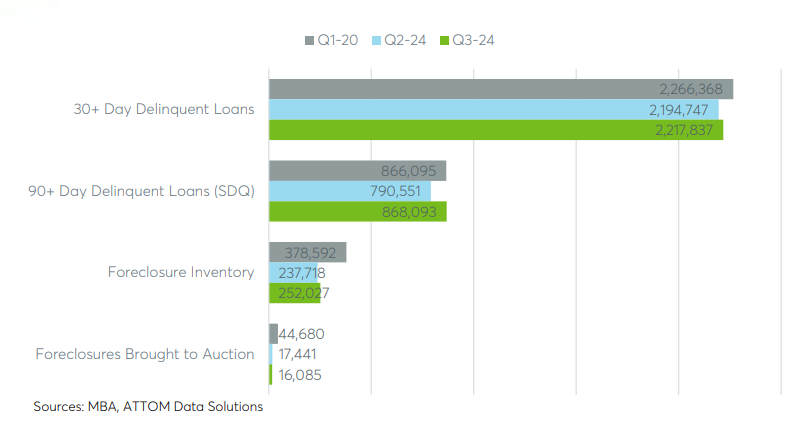
The volume of distressed loans upstream from completed foreclosure auctions shifted in Q3 of 2024, with seriously delinquent mortgages rising by 10% from the previous quarter. Despite this, foreclosure inventory remains significantly below pre-pandemic levels.
Ali Haralson, President of Auction.com, noted, “While the number of distressed homeowners has returned to pre-pandemic levels, many are avoiding foreclosure thanks to ample home equity that allows them to sell through a pre-foreclosure sale.”
2025 Foreclosure Outlook
Daren Blomquist, VP of Market Economics at Auction.com, stated, “Emerging risks in the economy and housing market are pushing delinquencies higher, but those higher delinquencies will not likely translate into higher foreclosure auction volume until at least early 2026.”
The report uses a regression-based model with home price appreciation and unemployment rates as primary inputs. It predicts a baseline 8% decrease in foreclosure auction volume for 2025. However, changes in these economic indicators could lead to varying outcomes.
This article is based on information from themortgagepoint.com, published one month ago.
More Articles
Getting licensed or staying ahead in your career can be a journey—but it doesn’t have to be overwhelming. Grab your favorite coffee or tea, take a moment to relax, and browse through our articles. Whether you’re just starting out or renewing your expertise, we’ve got tips, insights, and advice to keep you moving forward. Here’s to your success—one sip and one step at a time!
PropTech investment surged nearly 68% in 2025, hitting a massive $16.7 billion and surpassing pre-pandemic highs. Investors are shifting toward practical, AI-powered tools that streamline operations, improve efficiency, and deliver immediate results. With 2026 shaping up to be a year of selective but strong growth, real estate professionals who stay ahead of tech trends will gain a major competitive edge.
Florida homeowners are finally seeing real relief as Citizens Property Insurance Corp. unveils an average 8.7% rate decrease for 2026—its largest cut in over a decade. Sparked by recent legislative reforms, a calm hurricane season, and renewed competition from insurers reentering the state, the drop is poised to significantly impact homeowners, real estate professionals, and industry trainees across Florida.
Tampa’s commercial real estate market is still growing, but investors are shifting from rapid dealmaking to highly selective, detail‑driven decisions. Population growth, steady office demand, stabilizing industrial activity, and a rebound in retail are keeping the market strong, while health‑care properties are emerging as a major sector for 2026. The region’s next chapter is defined by precision, disciplined underwriting, and long‑term strategy rather than speed.
Homesage.ai has released a new AI-powered comps engine that cuts property valuation time from hours to seconds by analyzing hundreds of data points across listings, public records, and proprietary datasets. Designed for agents, investors, and lenders, the tool delivers highly accurate comparable properties and real-time market insights, giving professionals a competitive edge in today’s rapidly shifting housing landscape.
A panel of federal judges is closely examining whether the National Association of Realtors’ billion‑dollar antitrust settlements—and similar deals struck by major brokerages—are genuinely fair to the millions of buyers and sellers affected. With plaintiffs arguing that homebuyers’ rights were improperly dismissed and compensation falls far short of true losses, the court’s upcoming decision could reshape commission practices and spark one of the most significant structural shifts in modern real estate.
The SEC is proposing a dramatic shift in how it defines a “small” registered investment adviser — raising the threshold from under 25 million in assets to under 1 billion. The change would instantly reclassify about 96 percent of RIAs and could create ripple effects across mergers and acquisitions, integration planning, and breakaway adviser activity. While the move aims to reduce administrative burden, it may also introduce new complexities for firms scaling past the billion‑dollar mark.