Auction.com has unveiled its 2025 Distressed Market Outlook, projecting a potential 8% decrease in foreclosure auction volume for the upcoming year. This baseline scenario is complemented by two alternative forecasts which could see an increase in auction volumes based on differing economic conditions.
Jason Allnutt, CEO at Auction.com, highlighted the importance of their platform, stating, “The Auction.com marketplace provides rich, real-time data on supply, demand, and pricing for distressed properties sold at auction nationwide.” This data is crucial for forecasting trends in the retail housing market.
The report indicates that foreclosure auction volumes are set to hit a three-year low in 2024. This decline is attributed to increased market headwinds, such as rising retail inventory and persistently high mortgage rates, which have impacted local community developers.
Auction buyers have shown a decreased willingness to pay prices relative to the after-repair value of properties towards the end of 2024. However, signs of recovery were evident in November and December, as price demands began to climb.
Foreclosure Auction Supply
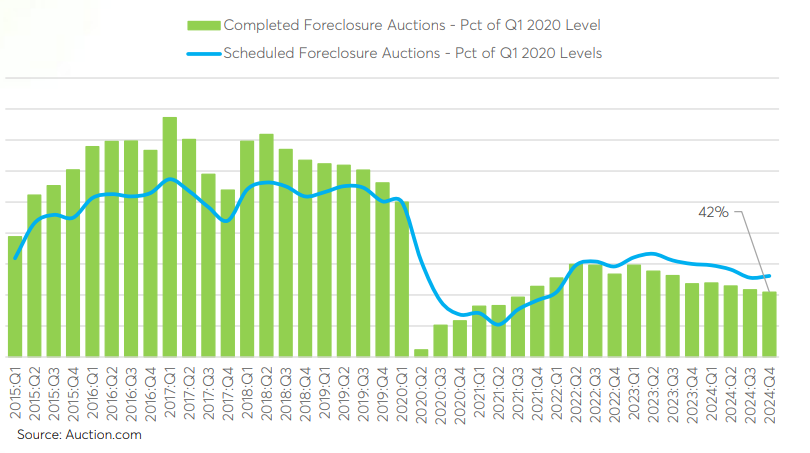
Completed foreclosure auction volume in Q4 of 2024 decreased by 3% from Q3 and was down 11% from the previous year, reaching its lowest since Q3 of 2021. Auction.com data, which represents nearly half of all completed foreclosure auctions nationwide, shows a 42% decrease from Q1 2020 levels.
REO Auction Supply
Bank-owned (REO) auction volume in Q4 of 2024 saw a 3% increase from Q3 and remained stable compared to the previous year. This volume is at 39% of Q1 2020 levels, marking a slight increase from earlier quarters.
Distressed Market Waterfall
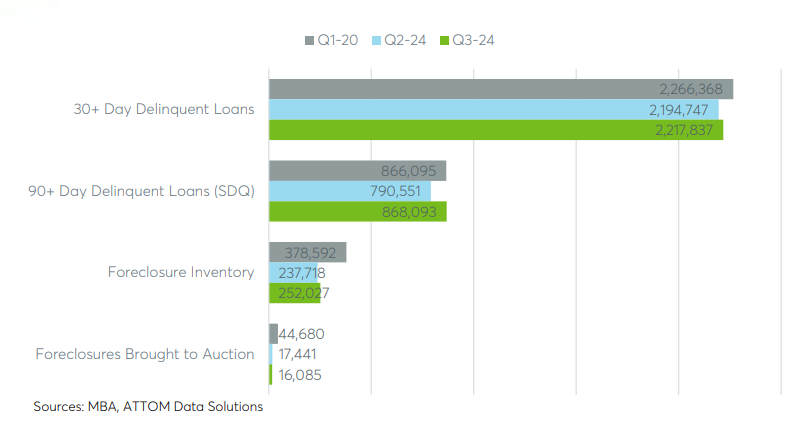
The volume of distressed loans upstream from completed foreclosure auctions shifted in Q3 of 2024, with seriously delinquent mortgages rising by 10% from the previous quarter. Despite this, foreclosure inventory remains significantly below pre-pandemic levels.
Ali Haralson, President of Auction.com, noted, “While the number of distressed homeowners has returned to pre-pandemic levels, many are avoiding foreclosure thanks to ample home equity that allows them to sell through a pre-foreclosure sale.”
2025 Foreclosure Outlook
Daren Blomquist, VP of Market Economics at Auction.com, stated, “Emerging risks in the economy and housing market are pushing delinquencies higher, but those higher delinquencies will not likely translate into higher foreclosure auction volume until at least early 2026.”
The report uses a regression-based model with home price appreciation and unemployment rates as primary inputs. It predicts a baseline 8% decrease in foreclosure auction volume for 2025. However, changes in these economic indicators could lead to varying outcomes.
This article is based on information from themortgagepoint.com, published one month ago.
More Articles
Getting licensed or staying ahead in your career can be a journey—but it doesn’t have to be overwhelming. Grab your favorite coffee or tea, take a moment to relax, and browse through our articles. Whether you’re just starting out or renewing your expertise, we’ve got tips, insights, and advice to keep you moving forward. Here’s to your success—one sip and one step at a time!
After years of soaring premiums and insurer instability, Florida’s property insurance market is finally turning a corner. Major carriers have filed 83 requests for rate decreases heading into 2026, with companies like Florida Peninsula and Patriot Select proposing cuts of 8.4% and 11.3%. Some homeowners may see relief as early as next month, signaling a long‑awaited shift toward market stability.
Fix-and-flip investing is gearing up for one of its strongest years in a decade as 2026 approaches. With cheaper capital, more accessible funding, easing interest rates, and long-awaited increases in housing inventory, investors are finding the perfect environment to launch or scale renovation-based real estate businesses. Renovation continues to outpace new construction in cost and speed, and demand for move-in-ready homes remains high, making 2026 a powerful opportunity window for both new and experienced investors.
After a short-lived period of relief in 2025, the U.S. rental market may be headed for a tighter, more expensive 2026. With construction starts dropping nearly 11% and completions plunging 42%, the surge of new apartments that helped lower rents is rapidly drying up. Rising costs, shrinking inventory, and a slowdown in new development point to a potential rental crunch that could leave renters facing heavier competition and higher prices across major markets next year.
The commercial real estate market is entering a rare reset that experts say mirrors the post‑2008 boom, creating a potential window for disciplined investors. With trillions in commercial debt coming due and property values dropping up to 40%, firms like AARE are positioning themselves to acquire assets below replacement cost—an advantage that could set the stage for significant long‑term growth.
Commercial real estate is entering a reinvention phase, with AI‑driven productivity, modernized office demand, experience‑focused retail, expanding industrial logistics, creative housing solutions, and sustainability‑centered design all accelerating nationwide. These six forces are shaping how investors, brokers, and future licensees will operate in a rapidly evolving U.S. market.
After years of economic uncertainty and cautious decision‑making, 2026 is shaping up to be the year professionals finally catch a break. AI is moving from buzzword to essential tool, capital markets are beginning to thaw, and hiring is picking up across real estate, mortgage, insurance, finance, and healthcare. With opportunity returning, many professionals are using this moment to upskill—pursuing new licenses, certifications, and cross‑industry expertise.