Commercial Real Estate Deal Growth Stalls: What Professionals Need to Know for 2026
Image courtesy of Cameron Academy
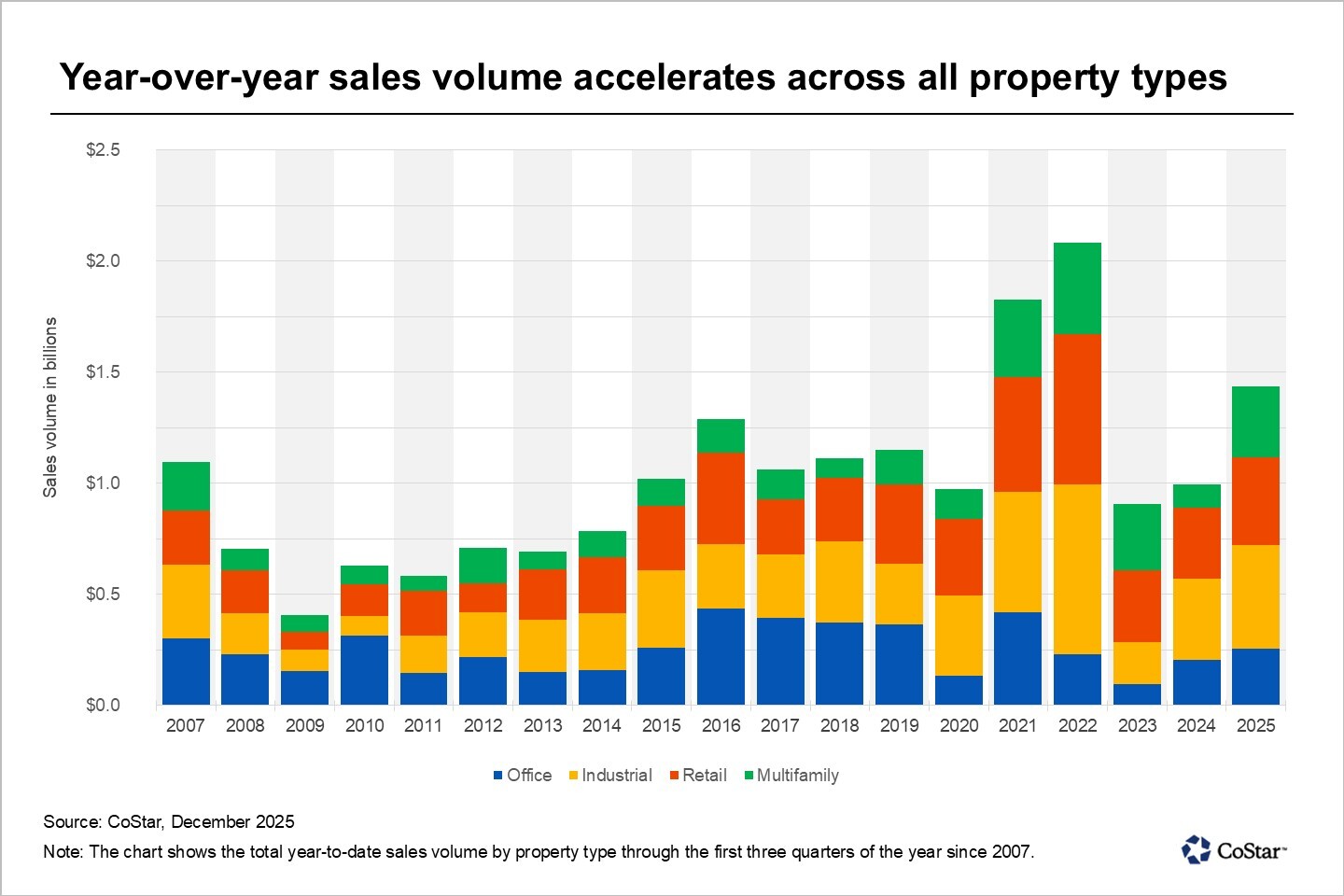
Commercial real estate investors tapped the brakes in October, delivering the first year‑over‑year slowdown in nearly two years and raising new questions about pricing expectations, interest rates, and what 2026 might hold for dealmakers. According to a recent report from Mortgage Professional America, the drop reflects a deepening disconnect between buyers and sellers — one shaped by persistent rate pressure and policy uncertainty.
A Market Caught in a Stalemate
Kevin Fagan, head of CRE capital market research at Moody’s, described the shift as less of a downturn and more of a “stalemate.” After a year of strength — especially across industrial and multifamily sectors — October marked the moment when the U‑shaped recovery from 2023’s lows began dragging.
Despite the slowdown, the month still brought in approximately $24.4 billion in sales, roughly 70% of October 2019 levels and above 2024 volumes. Yet transaction momentum has cooled sharply since 2023 as the cost of capital reshapes underwriting standards and reduces leverage across CMBS structures.
Multifamily Pulls Back While Hotels Push Forward
Multifamily — the darling of early‑2025 dealmaking — saw volumes fall 27% year‑over‑year in October. Many properties still trade above historical pricing, showing that investors value stable, income‑producing assets but want clearer rate direction before making aggressive offers.
Hotels, however, are telling a different story. Hospitality was the only sector to post higher year‑over‑year growth, up roughly 6%. A standout example: the New York Edition hotel at 5 Madison Avenue, purchased by Kam Sang Company for $231.2 million — a striking case of adaptive reuse and revitalized demand.
Similar wins at properties like the Woolworth Building highlight how conversions continue breathing life into once struggling office assets.
Office Sector: Discounts, Distress, and New Demand Drivers
Office investors are navigating both tough realities and fresh opportunities. The sale of Sotheby’s headquarters to Weill Cornell shows how medical and life‑science tenants are becoming essential in filling outdated space. Meanwhile, New York Life’s acquisition of a distressed Manhattan tower at nearly half its 2015 pricing reveals institutional appetite for discounted yet promising assets.
These shifts hint at a potential floor forming for office valuations — not a rapid rebound, but a healthier stabilization as we approach 2026.
Commercial Mortgage Originations Surge
Even as deal flow cools, mortgage activity is heating up. The Mortgage Bankers Association reported a 36% year‑over‑year jump in commercial and multifamily mortgage originations during Q3 2025, driven by a remarkable 181% surge in office lending.
Still, today’s lending climate is “volatile” and “unpredictable,” with strong preferences for industrial and multifamily over troubled office space.
Why This Matters for Professionals — and How Education Helps
For real estate, mortgage, finance, and insurance professionals, this shifting environment demands sharper analysis, stronger financial literacy, and a deep understanding of capital and market cycles.
Cameron Academy provides industry‑leading training for real estate, mortgage, insurance, finance, and more. Whether you’re beginning your professional journey or sharpening competitive skills, continuing education gives you the edge needed to thrive in evolving markets.
As the market awaits clarity on rates, pricing, and risk, informed professionals will be first to identify — and capitalize on — emerging opportunities in 2026.
More Articles
Getting licensed or staying ahead in your career can be a journey—but it doesn’t have to be overwhelming. Grab your favorite coffee or tea, take a moment to relax, and browse through our articles. Whether you’re just starting out or renewing your expertise, we’ve got tips, insights, and advice to keep you moving forward. Here’s to your success—one sip and one step at a time!
Artificial intelligence is rapidly reshaping the mortgage industry, boosting productivity, reducing manual work, and accelerating loan closings. From automated document data extraction to AI‑generated underwriting narratives and predictive analytics, lenders are using new tools that improve accuracy and drastically speed up processing times. With chatbots, next‑gen point‑of‑sale systems, and end‑to‑end automation, preapprovals that once took days now take minutes. For mortgage and real estate professionals, mastering AI is becoming a major competitive advantage—one that defines who will thrive in the future of lending.
Florida’s property insurance rates are finally starting to drop, but many homeowners are still seeing higher monthly bills. The reason isn’t insurer price hikes—it’s soaring replacement costs driven by construction inflation, labor shortages, and rising home values. Nearly 75 percent of recent premium increases came from higher property values alone. Understanding this gap between “rates” and “premiums” helps homeowners—and real estate and insurance professionals—navigate the shifting Florida market and make smarter coverage decisions.
Milwaukee’s commercial real estate market is finally showing real signs of recovery, with 2025 sales volume hitting a three‑year high and investor confidence steadily returning. Driven by selective, fundamentals‑focused buying—favoring strong cash flow, quality assets, and strategic pricing—the city is moving from a period of correction into a healthier, opportunity‑rich phase. For real estate professionals nationwide, Milwaukee’s momentum reflects broader CRE market stabilization and the growing importance of disciplined underwriting and market expertise.
Industry leaders project a major surge in reverse mortgage activity heading into 2026, fueled by rising proprietary products, lender innovation, and strong investor interest. As high interest rates push originators to adopt new strategies, flexible private‑label options, senior‑focused HELOCs, and a wave of big‑capital investment are reshaping the market. With education and policy shifts poised to unlock even more demand, reverse mortgages are entering their most transformative era yet.
Experts forecast that 2026 may bring long‑awaited relief to homebuyers, with both existing and new home inventory expected to rise. NAR predicts a boost in home sales, a slight drop in mortgage rates, and a modest 4% increase in prices—conditions that could motivate more homeowners to list while builders add over a million new homes to the market. For first‑time buyers, higher loan limits and easing qualification standards may make entering the market more achievable than in recent years.
South Florida enters 2026 with renewed optimism as falling mortgage rates, improving buyer confidence, and a strong job market help stabilize a housing landscape that struggled in 2025—especially in the condo sector. While single-family homes remained resilient last year, condos faced price drops, rising fees, and hesitation tied to new safety regulations. With rates projected to fall to around 5.8% by year’s end, buying power is increasing, inventory may loosen, and activity is expected to pick up. Still, affordability challenges persist, Miami’s rental market remains intensely competitive, and the condo sector’s recovery will take time.


 The Mortgage Industry’s AI Transformation: Automation Reshapes Lending From Application to Approval Gallery