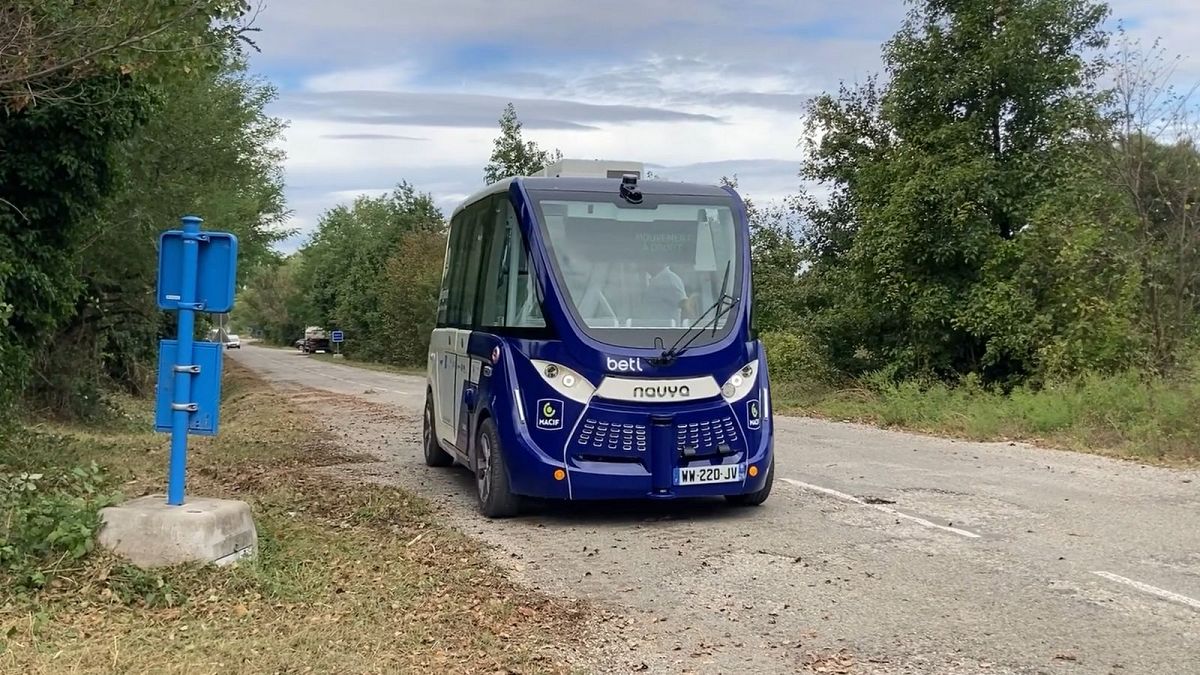
Driverless Shuttles: A New Era of Mobility in Rural France
In the picturesque yet sparsely populated region of Val de Drôme – Crest in southeastern France, a quiet revolution is underway. The deployment of self-driving shuttles is transforming the way residents navigate their rural surroundings. This initiative, launched in 2020, is part of a broader European effort to harness automated electric vehicles (EVs) as a viable public transport solution in areas where traditional services are often lacking.
Yann Arnaud, director of responses to customer needs and innovation at the French insurance company MACIF, emphasized the potential of these shuttles during a conversation with Euronews. “We are trying to ensure that this is a new means of travel and mobility for people living in suburban or rural areas,” he stated, highlighting the project’s aim to reduce isolation and improve accessibility.
Technology and Safety
The shuttles operate on a predefined 5 km route, making seven stops over a 20-minute journey. A control operator oversees the operation to ensure safety. Benjamin Beaudet, general director at Beti, the operator of the automated shuttles, explained that the technology aligns with the European vision for automated vehicles. The shuttles “learn” their routes and compare real-time observations with pre-learned data to navigate safely.
In contrast to American and Chinese companies like Waymo, Uber, and Tesla, which focus on self-driving taxis with flexible routes, the European approach prioritizes defined paths, enhancing safety and predictability.
Addressing Rural Needs
The introduction of these shuttles in Val de Drôme – Crest, where the population density is significantly lower than the national average, has been met with positive feedback. Residents appreciate the newfound mobility options, especially in areas where alternatives are limited. Arnaud noted, “The question of acceptability arises when you have the luxury of having other options. When you don’t have a choice, you’re very happy to have [the shuttle].”
This sentiment underscores the potential of driverless vehicles to address mobility challenges in rural areas, particularly for the elderly and those without access to personal transportation.
Challenges and Future Prospects
Despite the promising start, scaling these projects to permanent services remains a challenge. High costs, logistical hurdles, and technological requirements, as outlined in an Open Research Europe article, pose significant barriers. The EU has invested €159 million in research and innovation related to automated mobility since 2021, yet achieving commercial viability continues to be elusive.
The success of initiatives like AVENUE and SHOW, which have conducted pilot projects across Europe, including in Crest, offers hope. However, transitioning from pilot programs to sustainable, everyday solutions requires overcoming substantial obstacles.
As Europe continues to explore the potential of automated vehicles, the experiences in rural France provide valuable insights into the future of mobility. With continued innovation and investment, driverless shuttles could become a cornerstone of public transport in remote areas, offering a greener, more accessible alternative to traditional car use.
More Articles
Getting licensed or staying ahead in your career can be a journey—but it doesn’t have to be overwhelming. Grab your favorite coffee or tea, take a moment to relax, and browse through our articles. Whether you’re just starting out or renewing your expertise, we’ve got tips, insights, and advice to keep you moving forward. Here’s to your success—one sip and one step at a time!
Florida’s property insurance market is finally showing signs of recovery after years of soaring premiums, litigation chaos, and insurer withdrawals. With rate increases now the lowest in the nation, Citizens Insurance shrinking, and new carriers re‑entering the state, Insurance Commissioner Michael Yaworsky says the market is turning a corner. But while stabilization is underway, many homeowners are still asking why premiums haven’t dropped—and the answer lies in skyrocketing replacement costs, not rates. As reforms continue and AI, transparency rules, and mitigation incentives expand, real estate and insurance professionals should prepare for an evolving landscape that directly impacts affordability, buyer behavior, and long‑term market confidence.
In a candid conversation with Mortgage Professional America, NAMB president Kimber White lays out a series of structural reforms aimed at restoring homeownership access for millions of Americans. From revitalizing down payment assistance to rethinking loan-level price adjustments and incentivizing builders, White argues that meaningful affordability relief is achievable—but only through coordinated policy changes that address both costs and inventory shortages.
Artificial intelligence is rapidly transforming the insurance world, but a major power struggle is unfolding over who gets to regulate it. As insurers adopt AI at record speed, state regulators and the federal government are clashing over oversight authority—especially after a new executive order aims to put Washington in charge. With states pushing back and new evaluation tools on the horizon, the future of AI in insurance is becoming one of the biggest regulatory battles professionals need to watch.
A new CBRE Investor Intentions Survey shows that 2026 is shaping up to be a strong year for commercial real estate, with 95 percent of investors planning to buy more assets and over half increasing their capital allocation. Stabilizing pricing, improving market fundamentals, and expectations of cooling debt costs are driving renewed optimism as investors target high‑growth markets like Dallas, Atlanta, Tampa, and Charlotte, while doubling down on multifamily, industrial, and value‑add strategies.
Lofty has introduced Lofty AOS, the first agentic AI operating system built to autonomously manage real estate workflows—from lead engagement to marketing, transactions, and website creation. Unlike traditional AI that waits for prompts, Lofty’s system operates like a full digital workforce, coordinating tasks across specialized AI agents. As this technology transforms daily operations for agents and brokerages, professionals with strong training and licensing will become even more essential.
The Federal Reserve has started 2026 by keeping interest rates unchanged, despite political pressure, stubborn inflation, and a cooling job market. While consumers don’t pay the federal funds rate directly, its effects ripple through mortgages, credit cards, auto loans, and savings accounts. Mortgage affordability remains tight, credit card APRs are easing slowly, auto loan balances are climbing, and savings yields are one of the few bright spots. For real estate, mortgage, and finance professionals, understanding these shifts is essential as the market braces for another complex year.