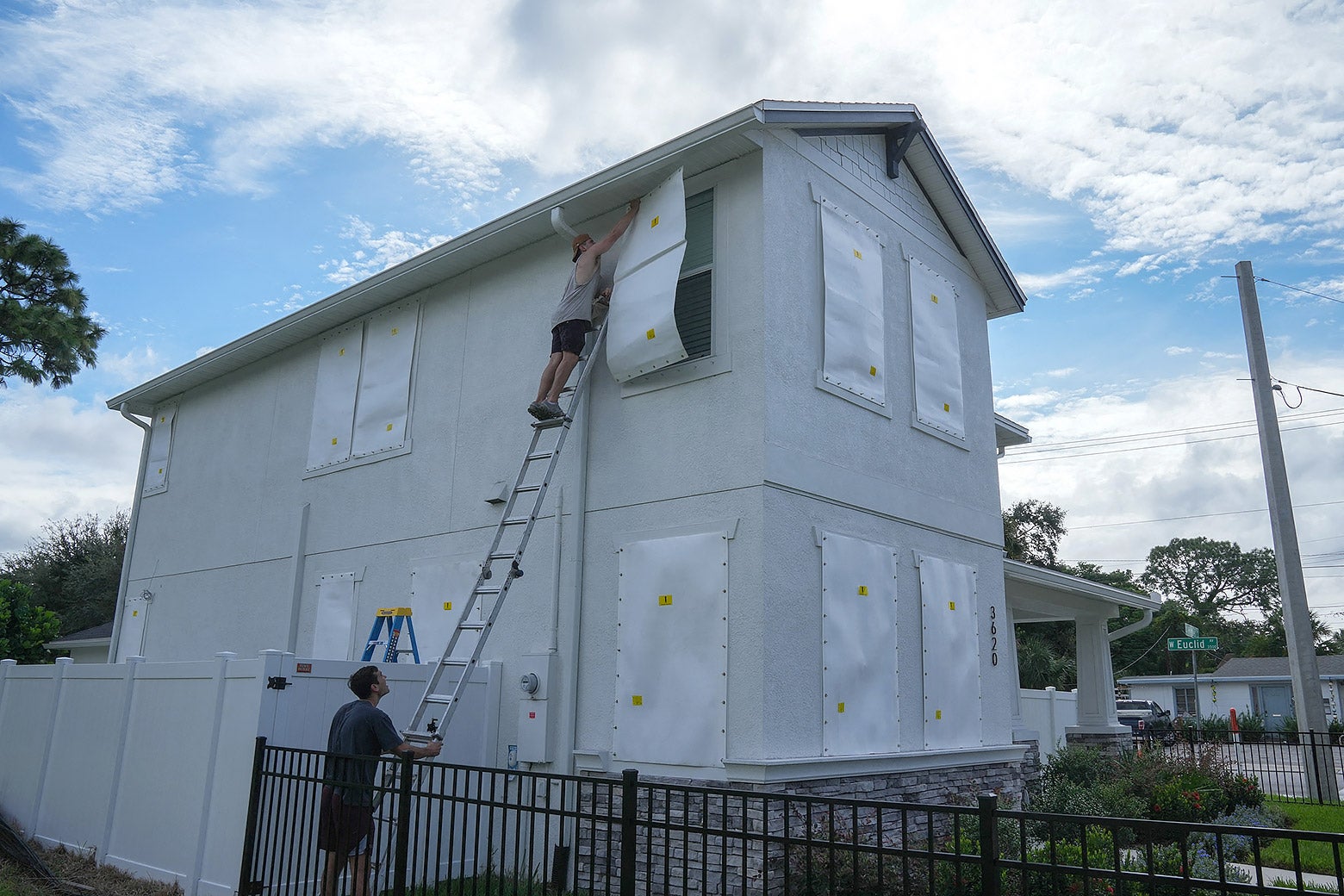
As Hurricane Milton looms over Florida’s Gulf Coast, residents brace for yet another bout of extreme weather. Despite the increasing frequency and intensity of hurricanes, wealthy homeowners in Florida seem unfazed. In fact, the impact of these natural disasters on the housing market is reshaping the demographic landscape, but not in the way one might expect.
A recent Slate article delves into the phenomenon of climate migration, revealing that it’s not leading to an exodus of affluent individuals from Florida. Instead, the hurricanes are driving up housing prices and attracting higher-income groups, while lower-income residents face displacement. This trend, often referred to as “climate gentrification,” contradicts the popular notion that wealthier households would relocate to safer areas.
Florida’s post-pandemic growth has been remarkable, with the state surpassing New York as the third-most populous in the U.S. Four of the nation’s five fastest-growing metro areas are in Florida, including Cape Coral–Fort Myers, which was severely impacted by Hurricane Ian in 2022. Yet, the Wall Street Journal warns of a potential unraveling of the state’s growth due to climate challenges.
However, the data suggests otherwise. Research by Joshua Graff Zivin highlights how hurricanes constrain housing supply, leading to increased demand and higher prices. Economic instability often results in evictions, as landlords replace long-standing tenants with higher-income newcomers. The costs of recovery, such as emergency reconstruction and higher insurance premiums, are more manageable for affluent households.
Moreover, hurricanes not only drive up housing prices but also lead to demographic changes. A study by the National Low Income Housing Coalition found that affluent communities tend to lose their low-income housing stock during recovery, as landlords are incentivized to redevelop existing low-cost rentals into higher-cost housing.
In response to these challenges, some regions are taking legislative action. For instance, Sonoma County in Northern California recently passed an ordinance to pause evictions during disaster declarations. This measure aims to counter the trend of rising evictions post-disasters, but Florida has yet to implement similar rules.
Despite the insurance crisis following Hurricane Helene, the Reforming Disaster Recovery Act proposes long-term federal funding for low-income housing after disasters. Yet, the design of federal disaster assistance can sometimes lead to price gouging. For instance, in Hawai’i, rental assistance after the Lahaina fire resulted in landlords raising prices and evicting tenants.
Ultimately, the allure of Florida’s coastal properties remains strong. Even as insurance premiums rise and maintenance costs increase, people continue to pay a premium to live in these risky areas. No disaster has yet altered this calculus.
Styling and Design
More Articles
Getting licensed or staying ahead in your career can be a journey—but it doesn’t have to be overwhelming. Grab your favorite coffee or tea, take a moment to relax, and browse through our articles. Whether you’re just starting out or renewing your expertise, we’ve got tips, insights, and advice to keep you moving forward. Here’s to your success—one sip and one step at a time!
In a significant business transaction, Old Republic International Corporation has sold its mortgage insurance business to Arch Capital Group Ltd. for a staggering $140 million. This strategic move marks a pivotal moment in the industry and will have far-reaching implications for both companies involved. Old Republic's exit from the mortgage insurance market is part of a strategy to refocus its resources on core business lines. For Arch Capital Group, the acquisition presents a tremendous opportunity for expansion, aiming to strengthen its position in the mortgage insurance market. This development will shape the landscape of the mortgage insurance market and have implications for both companies involved.
Welcome to a new era where home appraisals are completed in minutes, thanks to precise measurements and accurate property sketches. This is made possible by CoreLogic, a leading provider of property data and analytics, through their groundbreaking augmented reality (AR) tool, ScanToSketch. This tool is transforming the home appraisal process and its potential applications in the real estate industry. ScanToSketch leverages the power of Light Detection and Ranging (LiDAR) technology and augmented reality, enabling appraisers to capture precise measurements and create detailed property sketches in real-time. This advancement not only saves time but also ensures accuracy, revolutionizing the way home appraisals are conducted.
The recent verdict in the Sitzer/Burnett commission lawsuit has left the real estate industry in a state of uncertainty. The National Association of Realtors (NAR) and four major real estate brokerages, accused of inflating commission rates, are facing a $6.2 million judgment. NAR president Tracy Kasper, expressing disappointment at the verdict, plans to appeal the decision. This landmark decision has sent shockwaves through the industry, leaving agents uncertain about the future of their business. Kasper emphasizes the importance of transparency, communication, and staying informed about local regulations. Agents should proactively address any concerns or questions their clients may have about commission rates. It is crucial to provide clear explanations of the value agents bring to the transaction and ensure that clients understand all their choices.
In response to the affordability pressures in the housing market, 54 new homebuyer assistance programs were introduced in the third quarter, bringing the total number of such programs to 2,256. These programs aim to provide support and assistance to homebuyers, particularly those facing challenges in affording a home. The homebuyer assistance programs offer various types of aid, including down payment assistance, closing cost assistance, and low-interest loans. Companies and organizations across the country have introduced these programs to help potential homebuyers overcome financial barriers and achieve their homeownership goals. These programs are available in different states, with some states offering a higher number of programs compared to others.
Better Home & Finance Holding Company, a renowned digital lender based in New York, has recently made a groundbreaking move in the mortgage industry. In partnership with Infosys, a leading information technology consulting company, Better Home & Finance has launched a cutting-edge white-labeled mortgage-as-a-service platform. This innovative platform aims to revolutionize the mortgage process by providing an integrated end-to-end digital solution that streamlines every step of the lending journey. The mortgage-as-a-service platform handles all aspects of the mortgage process, from the initial point of sale to loan origination, underwriting, closing, funding, and investor sale. By leveraging advanced technology and automation, Better Home & Finance's platform reduces origination costs and helps partners navigate the operational volatility caused by the current interest rate environment.
Despite a decline in mortgage origination volume in Q3 2023, UWM Holdings Corporation, the parent company of United Wholesale Mortgage (UWM), showcased a robust financial performance. The company reported a net income of $1.6 billion, an increase from $1.5 billion in the previous quarter. This improvement in net income margin is a testament to UWM's resilience and adaptability in a fluctuating market. Even with a decrease in mortgage origination volume, UWM reported an increase in net income. This positive financial performance is attributed to UWM's strategic shift towards higher profitability loans, such as jumbo loans and non-QM loans. By focusing on these higher-margin loans, UWM has been able to maintain strong profitability despite the overall decline in volume.