Health Insurance Shake-Up: Why America’s Coverage Markets Are Entering a New Era

America’s health insurance landscape is changing—and fast. From power‑player insurers tightening their grip on group markets to an explosion of competition in the ACA individual marketplace, the past decade has redrawn the map of who covers whom, and at what cost. A new and comprehensive analysis from Peterson‑KFF delivers a rare, data‑driven look at exactly how competitive—or consolidated—our commercial insurance markets have become.

Whether you’re in insurance, finance, healthcare, business administration, or simply navigating your own coverage, these shifts are reshaping how Americans access care. And for career‑hungry professionals, understanding these dynamics is becoming nothing short of essential.

Source Spotlight: Data and insights courtesy of the brilliant analysts at the Peterson‑KFF Health System Tracker—one of the nation’s top authorities on healthcare performance and market trends.

One Big Trend: Group Markets Are Consolidating, While the Individual Market Opens Up

Fully insured group plans (both small and large employers) have become more concentrated than ever. Meanwhile, the individual market—fueled by the ACA—has seen a surge in competition and consumer choice.

In 2013, the dominant insurer in each state held roughly 56%–59% of the market across all segments. But by 2023, the picture split dramatically:

  • Group markets became more consolidated
  • The individual market saw dominance drop to 53%—meaning more players, more plans, more options
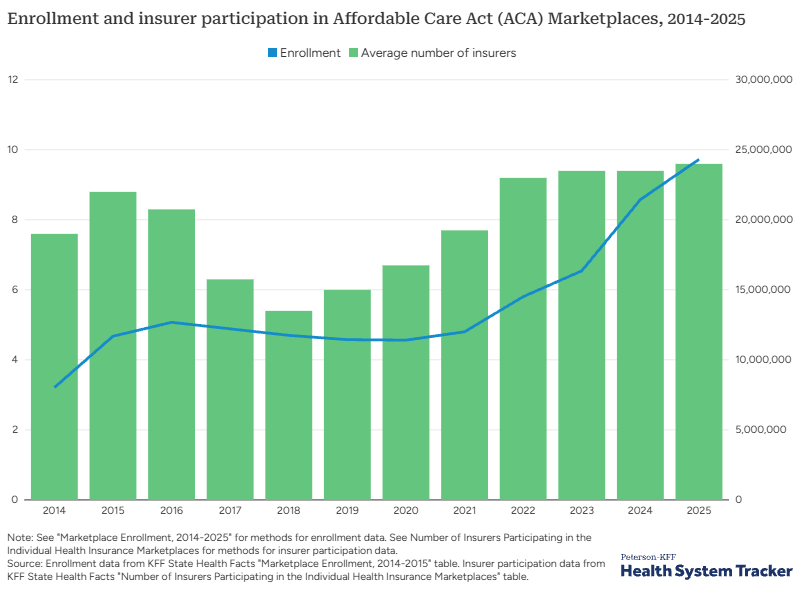
Aca marketplace participation chart

Why Employers Are Fleeing Fully Insured Plans

The fully insured market is shrinking. Large group enrollment fell from 46M in 2013 to 38M in 2023. Small group enrollment dropped from 17M to 10M.

So what’s happening?

Employers—especially large ones—are moving to self‑funded and level‑funded plans. These approaches offer companies more flexibility, cost control, and customization. By 2025, a stunning 67% of employees are covered under self‑funded structures.

Small businesses are joining the movement as well, driven by rising premiums and better hybrid funding options.

The Individual Market Is Thriving—For Now

ACA enrollment jumped from 11 million in 2013 to 18 million in 2023. Expanded subsidies played a huge part in making coverage affordable and attractive.

But a major policy cliff looms: enhanced tax credits expire at the end of 2025 unless Congress extends them. If not, premiums could double for many families, pushing an estimated 4 million Americans out of coverage.

One Insurer to Rule Them All? In Many States, Yes.

Market concentration remains extremely high. Some insurers dominate their state at stunning levels:

  • BCBS of Alabama: 94% of the large group market
  • Highmark (Delaware): 93% of individual market
  • Wellmark (Iowa): 90% of individual market

Even large states aren’t immune—North Carolina’s small group market is 82% controlled by a single insurer.

Record Competition in the ACA Marketplaces

Since 2018, insurers have flocked back to the ACA Marketplace. Urban regions now offer a rich tapestry of plans, while rural areas still lag but are improving. Both enrollment and participation are reaching record highs—making the ACA Marketplace healthier than it has been in years.

The Numbers Behind the Concentration: HHI

The government uses the Herfindahl‑Hirschman Index (HHI) to measure competition. In 2023:

  • 48 states + DC had highly concentrated large group markets
  • All 50 states + DC had highly concentrated small group markets
  • 47 states + DC had highly concentrated individual markets

Even with an improving ACA landscape, most segments still lean heavily toward consolidation.

Why This Matters for Professionals

Across insurance, finance, healthcare, HR, and business strategy, understanding these shifts helps professionals:

  • Advise clients on plan structures and cost trends
  • Prepare for policy impacts in 2025 and beyond
  • Spot career opportunities in a fast‑evolving industry
  • Navigate market swings with confidence

Want to get licensed or expand your professional credentials? Whether you’re pursuing insurance, finance, or real estate, Cameron Academy offers flexible, career‑boosting courses nationwide—helping you stay competitive as markets shift.

Final Takeaway

The U.S. health insurance system is in a pivotal period. Group plans are consolidating, self‑funding is exploding, the ACA individual market is more competitive than ever, and major policy changes could reshape everything again in 2025. The Peterson‑KFF analysis provides an essential blueprint for navigating these changes.

If you want to stay informed—and stay ahead—this is the moment to pay attention.

More Articles

Getting licensed or staying ahead in your career can be a journey—but it doesn’t have to be overwhelming. Grab your favorite coffee or tea, take a moment to relax, and browse through our articles. Whether you’re just starting out or renewing your expertise, we’ve got tips, insights, and advice to keep you moving forward. Here’s to your success—one sip and one step at a time!

Strategic Decision of RE/MAX: $55 Million Commission Lawsuit Settlement

In the competitive world of real estate, RE/MAX recently settled a commission lawsuit for a substantial $55 million. This strategic decision has sparked intrigue and raised questions about the company's future. The lawsuit, initiated by a group of real estate agents, accused RE/MAX of commission fraud and unfair practices. However, RE/MAX chose to settle the lawsuit, demonstrating its commitment to swiftly resolving legal matters and maintaining a positive trajectory. Despite the financial implications, RE/MAX remains financially robust and poised for future growth. The company's commitment to transparency, fairness, and ethical business practices remains steadfast. As the dust settles on the commission lawsuit settlement, RE/MAX looks to the future with unwavering confidence.

By |November 26, 2023|Categories: AI in Real Estate|Tags: |0 Comments

¡Ofrecemos el Curso de Pre-Licencia de Bienes Raíces de 63 Horas en Florida, 100% en Español!

¿Interesado en obtener una licencia de bienes raíces? Nuestra versión en español del curso de pre-licencia de bienes raíces de 63 horas está diseñada para personas que prefieren aprender en español. Nuestro currículo integral cubre temas esenciales desde principios de bienes raíces hasta la ley de contratos y ética. Con la flexibilidad del aprendizaje en línea, puedes adaptar tu educación inmobiliaria a tu apretada agenda. Inscríbete hoy y da el primer paso para convertirte en un profesional inmobiliario con licencia. ¡Inicia tu viaje en el mundo de los bienes raíces hoy mismo!

Bob Goldberg Steps Down as NAR CEO: A Leadership Change at the National Association of Realtors

The real estate industry is abuzz with Bob Goldberg stepping down as the CEO of the National Association of Realtors (NAR). This leadership change comes after the Sitzer/Burnett commission lawsuit trial, raising questions about NAR's practices. Goldberg's departure marks a significant moment in NAR's history, presenting an opportunity for reevaluation and rebuilding. As the industry evolves, NAR must adapt and embrace change to remain relevant. At Cameron Academy, we provide high-quality career education courses for a competitive advantage in the real estate industry. Start your journey towards success today! Explore Our Courses: https://cameronacademy.com/our-courses-cameron-academy

eXP CEO Glenn Sanford Voices Concerns About Commission Lawsuits’ Impact on Buyers

Commission lawsuits in the real estate sector are becoming increasingly prevalent, causing industry professionals to worry. Glenn Sanford, eXp World Holdings' CEO, recently voiced his fears about the potential repercussions of these lawsuits on low-income buyers. Sanford's primary worry centers around affordable housing access for low-income buyers. With the rise of commission lawsuits, Sanford is apprehensive that the legal costs will ultimately be shouldered by the buyers. This could further complicate the process for low-income individuals striving to enter the housing market and achieve homeownership. The Sitzer/Burnett verdict, which found real estate agents guilty of antitrust violations by conspiring to fix buyer broker commissions, has brought the issue of commission lawsuits to the forefront. The far-reaching implications of this verdict have ignited debates about the future of buyer broker commissions.

Perspectives on the Commission Lawsuit Trial: A Discussion Among Agents and Experts

The ongoing Sitzer/Burnett commission lawsuit trial has captured the attention of the real estate industry, as it holds the potential to reshape the way agent commissions are structured. In this article, we explore the viewpoints of brokers, agents, and real estate economists, who provide valuable insights into the possible outcomes of the trial and its implications for the industry. By examining their perspectives, we aim to shed light on the debate surrounding real estate agent commissions and the potential impact of this landmark trial.

By |November 24, 2023|Categories: Real Estate Industry|Tags: |0 Comments

New Reporting Obligations Imposed on Nonbank Financial Institutions by FTC

The Federal Trade Commission (FTC) has recently implemented a new rule that mandates nonbank financial institutions to report data breaches and other security events. This rule aims to enhance transparency and ensure the safety of customers' information. Nonbank financial institutions, including mortgage brokers, payday lenders, and virtual currency exchanges, must promptly report data breaches if they affect at least 500 customers and involve unauthorized access to unencrypted information. The FTC's new rule requiring nonbank financial institutions to report data breaches is a significant step towards ensuring transparency, accountability, and customer safety.