Health Insurance Shake-Up: Why America’s Coverage Markets Are Entering a New Era

America’s health insurance landscape is changing—and fast. From power‑player insurers tightening their grip on group markets to an explosion of competition in the ACA individual marketplace, the past decade has redrawn the map of who covers whom, and at what cost. A new and comprehensive analysis from Peterson‑KFF delivers a rare, data‑driven look at exactly how competitive—or consolidated—our commercial insurance markets have become.

Whether you’re in insurance, finance, healthcare, business administration, or simply navigating your own coverage, these shifts are reshaping how Americans access care. And for career‑hungry professionals, understanding these dynamics is becoming nothing short of essential.

Source Spotlight: Data and insights courtesy of the brilliant analysts at the Peterson‑KFF Health System Tracker—one of the nation’s top authorities on healthcare performance and market trends.

One Big Trend: Group Markets Are Consolidating, While the Individual Market Opens Up

Fully insured group plans (both small and large employers) have become more concentrated than ever. Meanwhile, the individual market—fueled by the ACA—has seen a surge in competition and consumer choice.

In 2013, the dominant insurer in each state held roughly 56%–59% of the market across all segments. But by 2023, the picture split dramatically:

  • Group markets became more consolidated
  • The individual market saw dominance drop to 53%—meaning more players, more plans, more options
Aca marketplace participation chart

Why Employers Are Fleeing Fully Insured Plans

The fully insured market is shrinking. Large group enrollment fell from 46M in 2013 to 38M in 2023. Small group enrollment dropped from 17M to 10M.

So what’s happening?

Employers—especially large ones—are moving to self‑funded and level‑funded plans. These approaches offer companies more flexibility, cost control, and customization. By 2025, a stunning 67% of employees are covered under self‑funded structures.

Small businesses are joining the movement as well, driven by rising premiums and better hybrid funding options.

The Individual Market Is Thriving—For Now

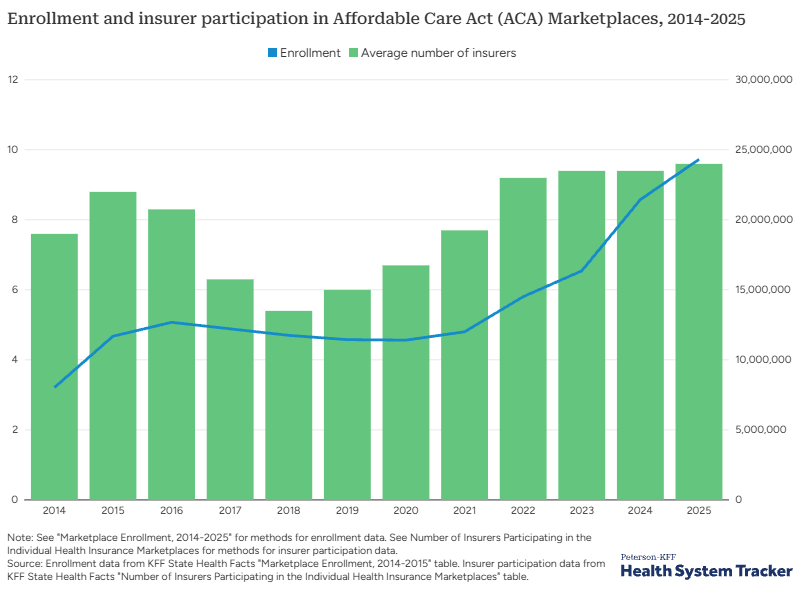
ACA enrollment jumped from 11 million in 2013 to 18 million in 2023. Expanded subsidies played a huge part in making coverage affordable and attractive.

But a major policy cliff looms: enhanced tax credits expire at the end of 2025 unless Congress extends them. If not, premiums could double for many families, pushing an estimated 4 million Americans out of coverage.

One Insurer to Rule Them All? In Many States, Yes.

Market concentration remains extremely high. Some insurers dominate their state at stunning levels:

  • BCBS of Alabama: 94% of the large group market
  • Highmark (Delaware): 93% of individual market
  • Wellmark (Iowa): 90% of individual market

Even large states aren’t immune—North Carolina’s small group market is 82% controlled by a single insurer.

Record Competition in the ACA Marketplaces

Since 2018, insurers have flocked back to the ACA Marketplace. Urban regions now offer a rich tapestry of plans, while rural areas still lag but are improving. Both enrollment and participation are reaching record highs—making the ACA Marketplace healthier than it has been in years.

The Numbers Behind the Concentration: HHI

The government uses the Herfindahl‑Hirschman Index (HHI) to measure competition. In 2023:

  • 48 states + DC had highly concentrated large group markets
  • All 50 states + DC had highly concentrated small group markets
  • 47 states + DC had highly concentrated individual markets

Even with an improving ACA landscape, most segments still lean heavily toward consolidation.

Why This Matters for Professionals

Across insurance, finance, healthcare, HR, and business strategy, understanding these shifts helps professionals:

  • Advise clients on plan structures and cost trends
  • Prepare for policy impacts in 2025 and beyond
  • Spot career opportunities in a fast‑evolving industry
  • Navigate market swings with confidence

Want to get licensed or expand your professional credentials? Whether you’re pursuing insurance, finance, or real estate, Cameron Academy offers flexible, career‑boosting courses nationwide—helping you stay competitive as markets shift.

Final Takeaway

The U.S. health insurance system is in a pivotal period. Group plans are consolidating, self‑funding is exploding, the ACA individual market is more competitive than ever, and major policy changes could reshape everything again in 2025. The Peterson‑KFF analysis provides an essential blueprint for navigating these changes.

If you want to stay informed—and stay ahead—this is the moment to pay attention.

More Articles

Getting licensed or staying ahead in your career can be a journey—but it doesn’t have to be overwhelming. Grab your favorite coffee or tea, take a moment to relax, and browse through our articles. Whether you’re just starting out or renewing your expertise, we’ve got tips, insights, and advice to keep you moving forward. Here’s to your success—one sip and one step at a time!

A Strategic Business Move: Old Republic’s Exit from the Mortgage Insurance Market

In a significant business transaction, Old Republic International Corporation has sold its mortgage insurance business to Arch Capital Group Ltd. for a staggering $140 million. This strategic move marks a pivotal moment in the industry and will have far-reaching implications for both companies involved. Old Republic's exit from the mortgage insurance market is part of a strategy to refocus its resources on core business lines. For Arch Capital Group, the acquisition presents a tremendous opportunity for expansion, aiming to strengthen its position in the mortgage insurance market. This development will shape the landscape of the mortgage insurance market and have implications for both companies involved.

Innovation in Home Appraisals: CoreLogic’s Augmented Reality Tool

Welcome to a new era where home appraisals are completed in minutes, thanks to precise measurements and accurate property sketches. This is made possible by CoreLogic, a leading provider of property data and analytics, through their groundbreaking augmented reality (AR) tool, ScanToSketch. This tool is transforming the home appraisal process and its potential applications in the real estate industry. ScanToSketch leverages the power of Light Detection and Ranging (LiDAR) technology and augmented reality, enabling appraisers to capture precise measurements and create detailed property sketches in real-time. This advancement not only saves time but also ensures accuracy, revolutionizing the way home appraisals are conducted.

Commission Lawsuit Uncertainty: A Guide for Agents

The recent verdict in the Sitzer/Burnett commission lawsuit has left the real estate industry in a state of uncertainty. The National Association of Realtors (NAR) and four major real estate brokerages, accused of inflating commission rates, are facing a $6.2 million judgment. NAR president Tracy Kasper, expressing disappointment at the verdict, plans to appeal the decision. This landmark decision has sent shockwaves through the industry, leaving agents uncertain about the future of their business. Kasper emphasizes the importance of transparency, communication, and staying informed about local regulations. Agents should proactively address any concerns or questions their clients may have about commission rates. It is crucial to provide clear explanations of the value agents bring to the transaction and ensure that clients understand all their choices.

By |November 27, 2023|Categories: Real Estate Industry|Tags: |0 Comments

Alleviating Housing Market Pressures: New Homebuyer Assistance Programs

In response to the affordability pressures in the housing market, 54 new homebuyer assistance programs were introduced in the third quarter, bringing the total number of such programs to 2,256. These programs aim to provide support and assistance to homebuyers, particularly those facing challenges in affording a home. The homebuyer assistance programs offer various types of aid, including down payment assistance, closing cost assistance, and low-interest loans. Companies and organizations across the country have introduced these programs to help potential homebuyers overcome financial barriers and achieve their homeownership goals. These programs are available in different states, with some states offering a higher number of programs compared to others.

Mortgage-as-a-Service Platform Launched by Better Home & Finance and Infosys

Better Home & Finance Holding Company, a renowned digital lender based in New York, has recently made a groundbreaking move in the mortgage industry. In partnership with Infosys, a leading information technology consulting company, Better Home & Finance has launched a cutting-edge white-labeled mortgage-as-a-service platform. This innovative platform aims to revolutionize the mortgage process by providing an integrated end-to-end digital solution that streamlines every step of the lending journey. The mortgage-as-a-service platform handles all aspects of the mortgage process, from the initial point of sale to loan origination, underwriting, closing, funding, and investor sale. By leveraging advanced technology and automation, Better Home & Finance's platform reduces origination costs and helps partners navigate the operational volatility caused by the current interest rate environment.

By |November 27, 2023|Categories: Digital Mortgage Services|Tags: |0 Comments

Surge in UWM’s Profits: Q3 Highlights

Despite a decline in mortgage origination volume in Q3 2023, UWM Holdings Corporation, the parent company of United Wholesale Mortgage (UWM), showcased a robust financial performance. The company reported a net income of $1.6 billion, an increase from $1.5 billion in the previous quarter. This improvement in net income margin is a testament to UWM's resilience and adaptability in a fluctuating market. Even with a decrease in mortgage origination volume, UWM reported an increase in net income. This positive financial performance is attributed to UWM's strategic shift towards higher profitability loans, such as jumbo loans and non-QM loans. By focusing on these higher-margin loans, UWM has been able to maintain strong profitability despite the overall decline in volume.

By |November 26, 2023|Categories: Mortgage Industry|Tags: |0 Comments