In a recent report from Realtor.com, down payments have shown a slight decline in the third quarter of 2024, yet they remain near the historic highs seen earlier this year. This shift comes after a peak in the second quarter, a trend influenced by a mix of seasonal forces and economic factors, including fluctuating mortgage rates and market dynamics.
Down Payments Ease but Remain High
The average down payment fell to 14.5% in Q3 2024 from the historical peak of 14.9% in Q2. This represents a modest decrease but still ranks as the third-highest percentage in recent history. The median down payment amount also dropped slightly to $30,300 from $32,700, reflecting the easing competition in the housing market.
Regional Disparities in Down Payment Trends
Regional differences are evident, with the Northeast states experiencing the most significant increases in down payments, while Southern states are witnessing declines. High-priced metros continue to demand larger down payments, but more affordable regions are seeing the most growth. This disparity highlights the ongoing impact of economic dynamics and buyer behavior across the nation.
The Role of Pandemic-Era Savings
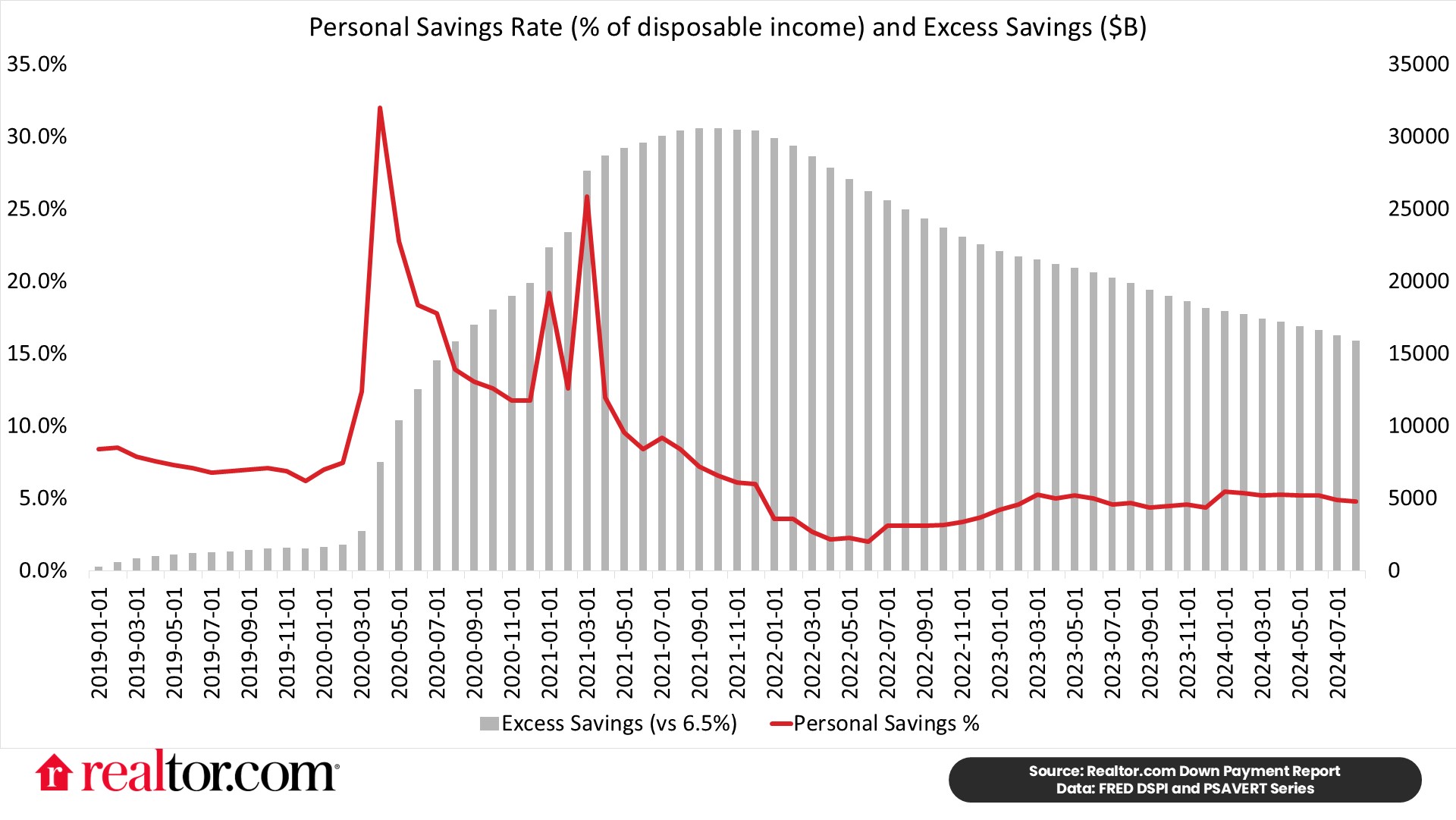
The influence of pandemic-era savings is still felt in the market. During the pandemic, personal savings rates surged, allowing many buyers to afford larger down payments. Although savings rates have since fallen, the accumulated savings continue to support consumer spending and home buying.
Impact of Falling Mortgage Rates
The recent drop in mortgage rates, which began in May and stayed below 7% from June, is expected to further impact down payment trends. As rates continue to fall, potential buyers might hold off in anticipation of even lower rates, or conversely, increased buyer competition could drive down payments upward again.
Primary Residences vs. Investment Properties
Primary residences typically see lower down payments compared to second homes and investment properties, which have down payments nearly double the typical share of primary residences. In dollar terms, down payments for investment and second homes were significantly larger than those for primary residences in Q3 2024.
Future Outlook
As we look ahead, the question remains whether this easing trend will continue or if down payments will climb again due to market conditions. The interplay of mortgage rates, personal savings, and housing market dynamics will continue to shape these trends.
Getting licensed or staying ahead in your career can be a journey—but it doesn’t have to be overwhelming. Grab your favorite coffee or tea, take a moment to relax, and browse through our articles. Whether you’re just starting out or renewing your expertise, we’ve got tips, insights, and advice to keep you moving forward. Here’s to your success—one sip and one step at a time!
Bluerate.ai—formerly MyMortgageRates—is stepping into 2025 with a mission to modernize a mortgage process that has barely changed in decades. Built by Zeitro, the platform equips both borrowers and loan officers with powerful AI tools, from online pre‑qualification and automated financial data extraction to instant guideline answers and scenario analysis. With more than 3,000 verified NMLS‑licensed loan officers and real‑time rate comparisons from major lenders, Bluerate.ai is quickly becoming a must‑know platform for mortgage and real estate professionals seeking speed, clarity, and a fully digital lending experience.
After the longest government shutdown in U.S. history, key federal housing programs such as FHA, VA, USDA, and NFIP are officially back in operation—offering long‑awaited relief to agents, lenders, and insurance professionals. But with a six‑week backlog slowing everything from loan guarantees to flood-insurance renewals, real estate pros should brace for delays and focus on resetting client expectations. A new federal spending deal restores funding through early 2026 and gives the market room to breathe, while NAR’s aggressive advocacy helped push the government toward reopening. Now, professionals who communicate clearly and stay on top of regulatory updates will be best positioned to guide clients through the temporary turbulence.
Commercial real estate is rapidly shifting toward a digital-first model, with platforms like Crexi leading the charge. By unifying property data, AI-driven insights, transparent bidding, and streamlined transaction tools, digital marketplaces are becoming essential to how modern CRE deals are sourced, analyzed, and closed. With more than 2 million monthly users and over $1 trillion in facilitated transactions, Crexi showcases how technology is reshaping the industry and giving real estate professionals a powerful competitive edge.
Europe’s biggest landlords—including Aroundtown, Vonovia, and top global investors—have teamed up to launch ATechX, a powerful new accelerator giving proptech startups something they rarely get: access to real buildings, real customers, and a clear path to scale across multiple countries. Designed to move founders beyond “pilot purgatory,” ATechX offers a true sandbox for innovation in Europe’s aging, regulation‑heavy property market, helping promising technology reach commercial traction faster than ever.
Mortgage rates are finally easing, inventory is climbing, and buyers are gaining leverage for the first time in years — yet sky‑high prices and economic jitters are keeping many on pause. With economists warning that inflation could push rates higher again, this fall may offer a rare window for well‑prepared buyers. Here’s what’s driving the shift, where opportunities are emerging, and how real estate professionals can stay ahead.
Griffin Funding has appointed John Jones as Senior Vice President of Growth and EOS Integrator, aiming to scale the company toward a $3 billion annual non-QM volume goal by 2030. After serving in fractional leadership roles since April 2025, Jones now steps in full‑time to lead organizational structure, efficiency, market expansion, and cross‑department alignment. Backed by strong liquidity and rising deal volume, Griffin Funding appears positioned for major industry impact in the years ahead.