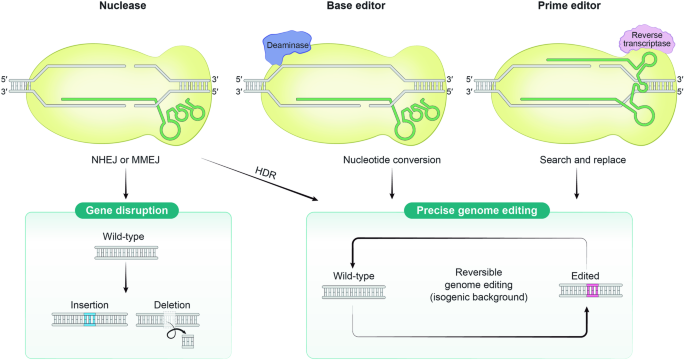
In the ever-evolving world of genetic research, the spotlight is now firmly on the groundbreaking capabilities of CRISPR-Cas technology. As highlighted in a recent Nature article, the integration of CRISPR-based genome editing with high-throughput sequencing technologies is revolutionizing our understanding of disease-associated genetic variants.
Unlocking the Secrets of Genetic Variants
For years, scientists have grappled with the challenge of deciphering the role of genetic mutations, particularly those classified as variants of unknown significance (VUSs). These mutations, often linked to human diseases, have remained elusive due to limited knowledge about their impact on cellular phenotypes. However, the advent of CRISPR-Cas technology is changing the game.
CRISPR-Cas, a precise genome editing tool, allows researchers to manipulate specific DNA sequences with unprecedented accuracy. As noted by Wang and Doudna, this technology is not just a tool but a gateway to understanding the genetic influences on diseases. By facilitating the study of both protein-coding and noncoding regions of the genome, CRISPR-Cas offers a comprehensive approach to unraveling the genetic underpinnings of various conditions.
The Power of High-Throughput Sequencing
The marriage of CRISPR technology with high-throughput sequencing has opened new avenues for functional genomics research. Techniques like Illumina and Oxford Nanopore Technology (ONT) are enabling the detailed analysis of genetic mutations on a massive scale. This integration allows scientists to conduct high-throughput screens, analyzing the functions of numerous genetic mutations simultaneously.
Moreover, advancements in single-cell sequencing are enhancing the granularity of genetic studies. By examining individual cells, researchers can gain deeper insights into the specific effects of genetic knockouts and the global changes in gene expression they induce.
CRISPR’s Role in Precision Medicine
The implications of these advancements are profound, particularly in the realm of precision medicine. By providing a detailed understanding of genetic variants, CRISPR-Cas technology holds the potential to transform diagnostic and therapeutic approaches. Researchers are now able to create isogenic disease models, facilitating the accurate analysis of phenotypic changes resulting from specific genetic mutations.
Furthermore, the ability to study noncoding regions and regulatory elements expands the scope of genetic research, offering new possibilities for therapeutic interventions targeting genetic disorders at their root.
Challenges and Future Directions
Despite its promise, CRISPR technology is not without challenges. The efficiency of gene editing varies, and the risk of unintended genomic alterations remains a concern. However, ongoing research and technological advancements continue to address these limitations, paving the way for broader applications in various fields.
As the scientific community delves deeper into the world of CRISPR-based functional genomics, the potential for groundbreaking discoveries is immense. With each new development, we move closer to a future where precision medicine is not just a possibility but a reality.
More Articles
Getting licensed or staying ahead in your career can be a journey—but it doesn’t have to be overwhelming. Grab your favorite coffee or tea, take a moment to relax, and browse through our articles. Whether you’re just starting out or renewing your expertise, we’ve got tips, insights, and advice to keep you moving forward. Here’s to your success—one sip and one step at a time!
Long Island’s commercial real estate market just smashed every previous record, hitting an unprecedented $4.1 billion in 2025 deal volume—up a massive 71.5 percent from the year before. A surge in specialty-use properties like assisted living centers and self-storage facilities fueled the boom, alongside hundreds of new transactions across Nassau and Suffolk counties. With investor confidence rebounding, interest rates easing, and new buyer profiles entering the scene, the region has become one of the hottest real estate markets to watch.
Federal cuts to housing oversight in 2026 are creating a nationwide regulatory scramble, with states—especially California—rapidly stepping in to fill the gap. As the CFPB reduces its enforcement role, lawmakers and agencies across the country are crafting their own rules on mortgage compliance, consumer protection, affordability, and even AI‑driven underwriting. For real estate, mortgage, and finance professionals, the message is clear: state regulations are becoming just as influential as federal policy, making ongoing education and compliance awareness more critical than ever.
The insurance industry poured an eye‑opening $172 million into federal lobbying in 2025, making it the fourth‑largest lobbying sector in the country. Medical insurers led the spending, but property and casualty giants weren’t far behind, with APCIA, Nationwide, Liberty Mutual, and Allstate all landing among the top contributors. And this is only federal spending—state‑level influence, where regulations are truly shaped, remains vastly underreported. For professionals in insurance, real estate, and finance, these lobbying efforts play a powerful role in shaping regulations, costs, and the competitive landscape.
Florida’s home insurance market saw a 3.35% non-renewal rate last year—a small percentage that translated into hundreds of thousands of homeowners suddenly losing coverage. Driven by repeated storm damage, soaring construction costs, heavy litigation, and insurers pulling back from high-risk areas, the state’s insurance landscape is rapidly shifting. Homeowners now face higher premiums, fewer options, and tougher underwriting, while professionals in real estate, mortgage, and insurance must stay informed to guide clients through a tightening market.
Florida’s recent tort reforms are doing far more than reshaping the state’s legal system—they’re driving down property and casualty insurance costs by an average of 14.5% and injecting over $4.2 billion into the state’s economy each year. With nearly 30,000 jobs supported and state and local governments seeing hundreds of millions in new tax revenue, the changes are already transforming Florida’s insurance market. Lawsuits have dropped, insurers are returning, and businesses and homeowners alike are reaping the benefits of a more balanced, competitive, and financially resilient environment.
Major commercial real estate firms are reporting strong revenue and renewed market activity, signaling a rebound in dealmaking and office demand. Yet even with record earnings, CEOs from CBRE, Colliers, and Marcus & Millichap spent much of their earnings calls addressing a growing concern: whether artificial intelligence could threaten traditional brokerage and valuation roles. While leaders insist that complex transactions still rely on human relationships and negotiation, AI‑related market jitters briefly pushed some CRE stocks down before they recovered.