Rising Home Insurance Costs Are Quietly Reshaping America’s Real Estate Market
Across the United States, a new force is beginning to reshape local real estate markets — and it isn’t mortgage rates, inflation, or even inventory shortages. It’s home insurance. In the most disaster‑prone areas, skyrocketing premiums are eating directly into home values, upending long‑held assumptions about affordability, risk, and long‑term investment viability.
The New York Times recently published a deeply reported investigation into this rapidly expanding crisis, revealing how rising premiums — often fueled by global reinsurance upheavals — are placing thousands of homeowners under intense financial pressure. Their reporting, grounded in national data and real‑world interviews, highlights an emerging trend that real estate professionals must watch closely.
When Insurance Becomes the Dealbreaker
In coastal Louisiana, residents are facing insurance increases that would have seemed unimaginable just a few years ago. Sandra Rojas, a fifth‑generation resident of Lafitte, saw her annual premium soar to $8,312 — more than double what she paid four years earlier. She considered selling, but with home values in her region down 38% since 2020, her options are limited. “You’re kind of stuck where you are,” she said.
Similar stories are emerging nationwide. In Colorado, buyers are walking away from deals after failing to secure affordable wildfire coverage. In California, 13% of real estate agents report transactions falling apart because buyers couldn’t obtain insurance at all.
New research from the National Bureau of Economic Research provides numbers to match the stories. Disaster‑exposed ZIP codes are seeing home values fall in direct response to rising insurance costs. According to researchers Benjamin Keys and Philip Mulder, homes in the top 10% most exposed areas are selling for an average of $43,900 less than they would have otherwise.
Their study of 74 million payment records from 2014–2024 found that nearly one‑fifth of the national increase in premiums since 2017 is tied to “rapid repricing” of climate‑driven risks. Meanwhile, global reinsurers — absorbing mounting losses — have doubled the rates they charge insurers, who then pass the burden directly to homeowners.
A Growing National Ripple Effect
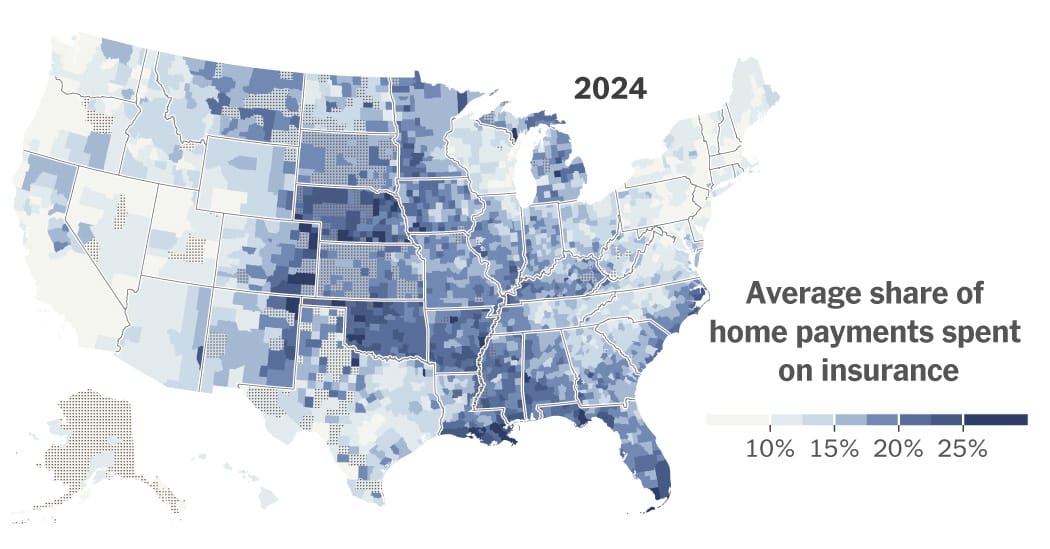
In hail‑risk Midwest states, insurance now consumes more than 20% of total housing payments. In parts of Louisiana, it exceeds 30%. For buyers, this means steeper monthly costs. For sellers, it means fewer qualified buyers and declining property values.
Some homeowners are even dropping coverage entirely. In Lafitte, Clarence Guidry received a quote for a $20,000 premium — plus a $50,000 hurricane deductible. Unable to sustain the cost, he paid off his mortgage and now self‑insures. He’s not alone: 13% of U.S. homeowners are now uninsured.
What This Means for Real Estate and Professional Licensees
Insurance‑driven pricing pressures are no longer hypothetical — they are here, reshaping how agents, lenders, appraisers, and insurance professionals work. Deals stall, lenders tighten, buyers hesitate, and municipalities face shrinking tax revenue as home values cool.
For professionals, especially those working in high‑risk states like Florida, staying current on these shifts is essential. Cameron Academy offers real‑estate and insurance licensing education designed to help professionals understand not only the rules of their industry but also the evolving economic forces that shape it. Understanding how climate‑risk and insurance impacts property value is now a core professional skill.
Looking Forward
As reinsurers adjust their risk models and climate‑driven disasters grow more severe, insurance premiums are projected to keep rising. Industry analysts expect home values in high‑risk markets to adjust further downward as buyers push for affordability.
For many Americans, the dilemma is becoming painfully clear: pay soaring premiums, sell at a loss, or self‑insure and hope for the best.
Real estate, insurance, lending, and financial professionals will need to stay educated and adaptable — and up‑to‑date training is one of the most powerful tools available.
Getting licensed or staying ahead in your career can be a journey—but it doesn’t have to be overwhelming. Grab your favorite coffee or tea, take a moment to relax, and browse through our articles. Whether you’re just starting out or renewing your expertise, we’ve got tips, insights, and advice to keep you moving forward. Here’s to your success—one sip and one step at a time!
A fast‑growing Israeli startup called Agora is reshaping how real estate investment firms operate by replacing outdated spreadsheets and scattered emails with a seamless digital platform. Built by former military intelligence technologists, Agora centralizes investor onboarding, reporting, financial tracking and communication—giving firms a modern backbone for managing complex portfolios. As proptech adoption accelerates worldwide, understanding tools like Agora is becoming essential knowledge for new and seasoned real estate professionals alike.
Canada remains one of the fastest and most accessible places to launch a real estate career, with no university degree required and most provinces offering licensing timelines under a year. This guide breaks down every major step—eligibility, education, exams, brokerage registration, and income expectations—while comparing requirements across Ontario, BC, Alberta, and Quebec. It also highlights what truly separates successful agents from those who leave the profession: consistent prospecting, strong preparation, and long-term discipline.
The 2026 housing market is starting off with colder-than-usual activity but warmer opportunities for buyers. Mortgage rates have dipped nearly a full percentage point from last year, inventory is slowly increasing, and competition is easing just enough to give buyers more leverage. While prices are still rising, the pace has cooled, and motivated sellers are becoming more flexible. Whether you're planning to buy or preparing clients as a real estate professional, the key message remains the same: the right time to purchase depends far more on your financial readiness than on headline noise.
More landlords than ever are turning to LLCs to protect their assets, streamline operations, and unlock tax advantages. An LLC can separate your personal finances from your rental business, provide liability protection, and offer valuable tax benefits. This article breaks down what LLCs do for landlords, how they affect taxes, the benefits they bring, and the best practices for setting one up in 2025—giving real estate professionals and investors a clear, practical guide for making the right decision.
Florida lawmakers have approved Sen. Joe Gruters proposal to push more commercial properties from Citizens Property Insurance into the private market. The bill tightens eligibility rules, expands the clearinghouse process, and could shift about 25 billion dollars in risk to private carriers. Supporters say the change reduces taxpayer exposure after major storms, while opponents worry about relying more on the less-regulated surplus lines market. The measure now heads to Gov. Ron DeSantis for final approval.
Wire fraud has evolved into a major danger for Florida real estate transactions, with criminals hijacking email accounts, impersonating buyers and sellers, and creating fake title company websites. First‑time buyers are especially vulnerable, and losses often occur right before closing when emotions are high. Experts warn that nearly all wire fraud can be prevented with proper verification, secure communication, and professional training—making education a critical defense for today’s real estate professionals.