Tampa Bay’s Office Market Closes 2025 with Power Moves and Rising Demand
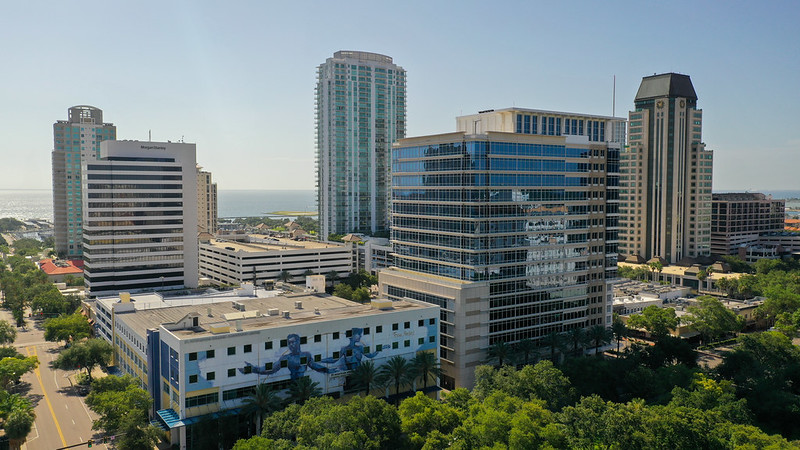
If you’ve been wondering whether the Tampa Bay office market still has momentum after the last few years of national uncertainty, JLL’s newest Q4 2025 analysis has a clear answer: absolutely. Tampa Bay just wrapped its strongest performance since before the pandemic, marking one of the most impressive post‑recovery surges in the country.
The report — published by global real estate leader JLL and highlighted by the St. Pete Catalyst — reveals a powerful combination of rising demand, shrinking inventory, and firming rents. While many U.S. cities continue battling stubborn vacancies, Tampa Bay appears to be accelerating.
Record Absorption, Falling Vacancy & a Tightening Market
The headline number is stunning: Tampa Bay recorded 600,400 square feet of positive net absorption in 2025 — the highest total since 2016. This pushed the overall vacancy rate down 130 basis points to 15.7%.
Momentum snowballed throughout the year, with more than 150,000 square feet absorbed in each of the final three quarters. This performance places Tampa Bay among the top U.S. office markets for year‑end absorption.
The Plot Twist: Inventory Is Shrinking
Even though developers delivered 176,400 square feet of new office product, the region’s total inventory actually declined by more than 750,000 square feet in 2025. Older buildings were demolished or converted, tightening the pipeline and boosting competition for modern space.
By year’s end, total available space had dipped below 8.6 million square feet, reflecting a significant year‑over‑year contraction.
Big Leases Set the Stage for 2026
Two major commitments dominated headlines: Fisher Investments leased 322,000 square feet at Renaissance Office Park, while GEICO claimed 189,000 square feet at Corporate Oaks Office Park.
Neither tenant has fully occupied their space yet — meaning early 2026 could show even stronger absorption numbers.
Flight to Quality Reshapes the Region
Across Tampa CBD, Westshore, and downtown St. Pete, tenants continue gravitating toward modern, amenity‑rich offices. Trophy and Class A vacancy fell to 14.7% — the strongest since 2022 — with six of seven submarkets posting year‑over‑year improvements.
Absorption in top‑tier buildings reached roughly 368,000 square feet, driving vacancy down to just 12.9%. Rents followed, rising 7.1% to an average of $45.46 per square foot.
What It Means for Tenants, Investors & Professionals
Tenants are increasingly willing to pay premium rates for newer buildings, better amenities, and stronger locations. With downtown St. Pete offering limited inventory, competition is expected to sharpen.
For investors and landlords, rising rents and shrinking supply signal a long‑awaited swing toward leverage.
Looking Ahead: Rising Confidence in 2026
JLL’s outlook for 2026 is cautiously optimistic. With economic diversity, strong employers, and limited new construction, Tampa Bay’s office market seems poised for continued strength — and potentially higher rents.
Put simply, Tampa Bay isn’t just recovering — it’s redefining its trajectory.
If this momentum inspires you to elevate your real estate career, consider sharpening your skills with Cameron Academy — Florida’s trusted hub for professional licensing education.
More Articles
Getting licensed or staying ahead in your career can be a journey—but it doesn’t have to be overwhelming. Grab your favorite coffee or tea, take a moment to relax, and browse through our articles. Whether you’re just starting out or renewing your expertise, we’ve got tips, insights, and advice to keep you moving forward. Here’s to your success—one sip and one step at a time!
After years of sluggish commercial real estate performance, falling interest rates may finally set the stage for a market rebound. As the Federal Reserve signals further cuts, investors are eyeing REITs—and especially the Direxion Real Estate Bull 3X ETF (DRN), a leveraged fund designed to triple the daily movement of major commercial real estate stocks. DRN offers powerful upside potential during a rally, but its high‑risk, short‑term nature means it’s best suited for experienced traders who understand volatility and the mechanics of leverage.
A new proposal in Florida’s legislature could reshape the path to homeownership for working residents. House Bill 311, championed by State Rep. Jervonte Edmonds, would require certain private employers to contribute up to $5,000 toward their first-time homebuyer employees’ down payments or closing costs. Backed by bipartisan support, the bill ties employer tax write-offs directly to helping workers purchase homes, marking a unique approach to housing affordability. Now moving through committee, HB 311 could become one of the nation’s most innovative employer-assisted housing programs.
Artificial intelligence is pushing the real estate industry to confront a long‑standing problem: its data is fragmented, inconsistent, and nearly impossible for AI systems to interpret. From leases and rent rolls to county records and work orders, nothing is standardized, making AI adoption costly and inefficient. Industry leaders are now turning toward shared data standards and ontologies—like OSCRE’s “smart data highway”—to create cleaner, interoperable information systems. As real estate evolves, professionals who understand data and AI will have a major advantage, and schools like Cameron Academy are helping prepare them for this shift.
The U.S. housing market stumbled into 2026 as January home sales tumbled 8.4% from December, hitting their lowest pace in over a year. With inventory still tight, prices rising, and market activity stagnating, NAR’s chief economist warns that Americans—especially renters—are “stuck” in a new kind of housing crisis. Despite improving affordability on paper, sluggish movement and regional declines signal a market demanding sharper strategy and adaptability from today’s real estate professionals.
A fresh 2026 analysis reveals the top home insurance companies in the U.S., breaking down which carriers offer the best value, coverage options, and customer satisfaction. State Farm leads for customer experience, American Family shines for first-time buyers, and Allstate, Farmers, and Nationwide each earn top marks in specialized categories. With Florida’s premiums surging to more than double the national average, industry pros and homeowners alike gain a clear advantage by understanding which insurers remain strong—especially as weather risks, insurer withdrawals, and rising reconstruction costs reshape the market.
A new Perryman Group analysis shows Florida’s 2022–2023 insurance reforms are paying off, lowering property‑casualty costs by 14.5% and generating more than $4.2 billion in economic activity. With over 29,000 jobs created and premium increases nearly flat in 2025, the state’s long‑troubled insurance market is finally stabilizing as major carriers reduce rates and return to the market.