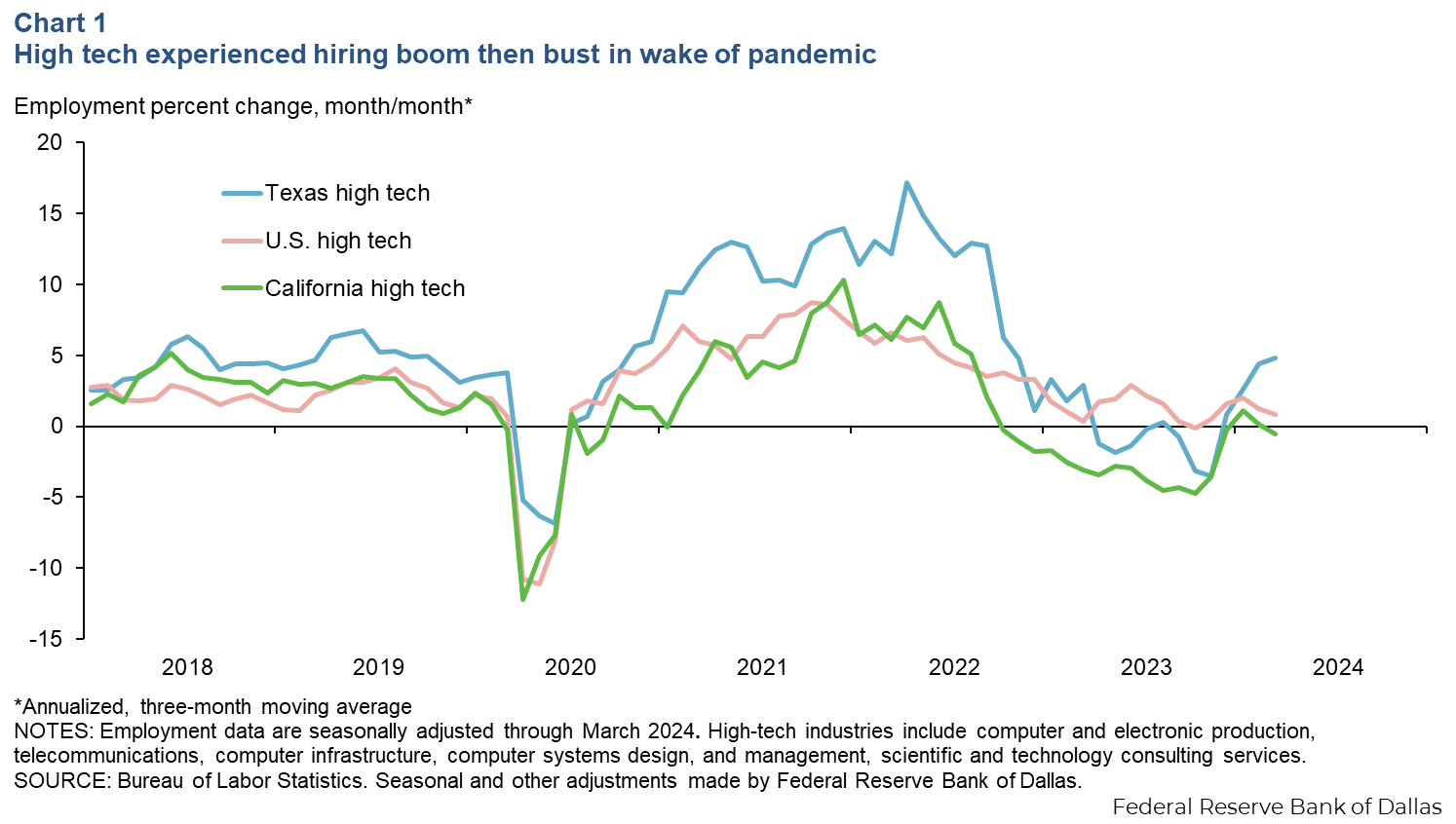
As the dust settles from the pandemic, Texas’ high-tech sector is shaking off its post-pandemic slump and gearing up for a new growth trajectory. The state, already a significant player in the U.S. economy, is poised for further expansion as it attracts business relocations from other tech hubs like Silicon Valley and rides the wave of increased demand for emerging AI technologies.
High tech contributes nearly 5% to Texas’ GDP and over 9% to employment, making it an essential driver of innovation and technological development. This sector, characterized by rapid growth and high wages, is crucial for productivity and is positioned to benefit from ongoing business relocations and new investments in high-tech manufacturing capacity. For more insights into the sector’s impact, visit the Federal Reserve Bank of Dallas.
High-Tech Hiring Dynamics
The high-tech industry experienced a hiring boom post-pandemic, driven by the surge in demand for technology products and services. However, this rapid expansion led to overhiring, and companies soon faced cost pressures, resulting in layoffs. Despite these challenges, Texas managed to avoid the severe job losses seen in California, thanks in part to the reallocation of tech activity to other parts of the country.
Layoff announcements in Texas spiked during early 2023 but have since moderated, suggesting stabilization in the local tech labor market. The state’s resilience is attributed to gains in computer manufacturing and tech consulting services, which offset losses in other tech industries.
Legislative Support and Future Outlook
The federal CHIPS and Science Act, along with the Texas CHIPS Act, provides significant support to the high-tech sector. These initiatives encourage semiconductor manufacturing, helping stabilize supply chains and aiming for technological self-sufficiency. Investments include Texas Instruments’ $30 billion semiconductor manufacturing plant and Samsung’s $44 billion investment in semiconductor facilities.
Corporate relocations and population migrations have also fueled high-tech growth in Texas. Major companies like Hewlett Packard and Apple have moved to Texas, bringing along a highly skilled workforce from states like California and New York. This influx of talent has bolstered the state’s high-tech sector, making it a pillar of Austin’s economy. For more on corporate relocations, see the Dallas Fed’s report.
Skilled Labor and Remote Work
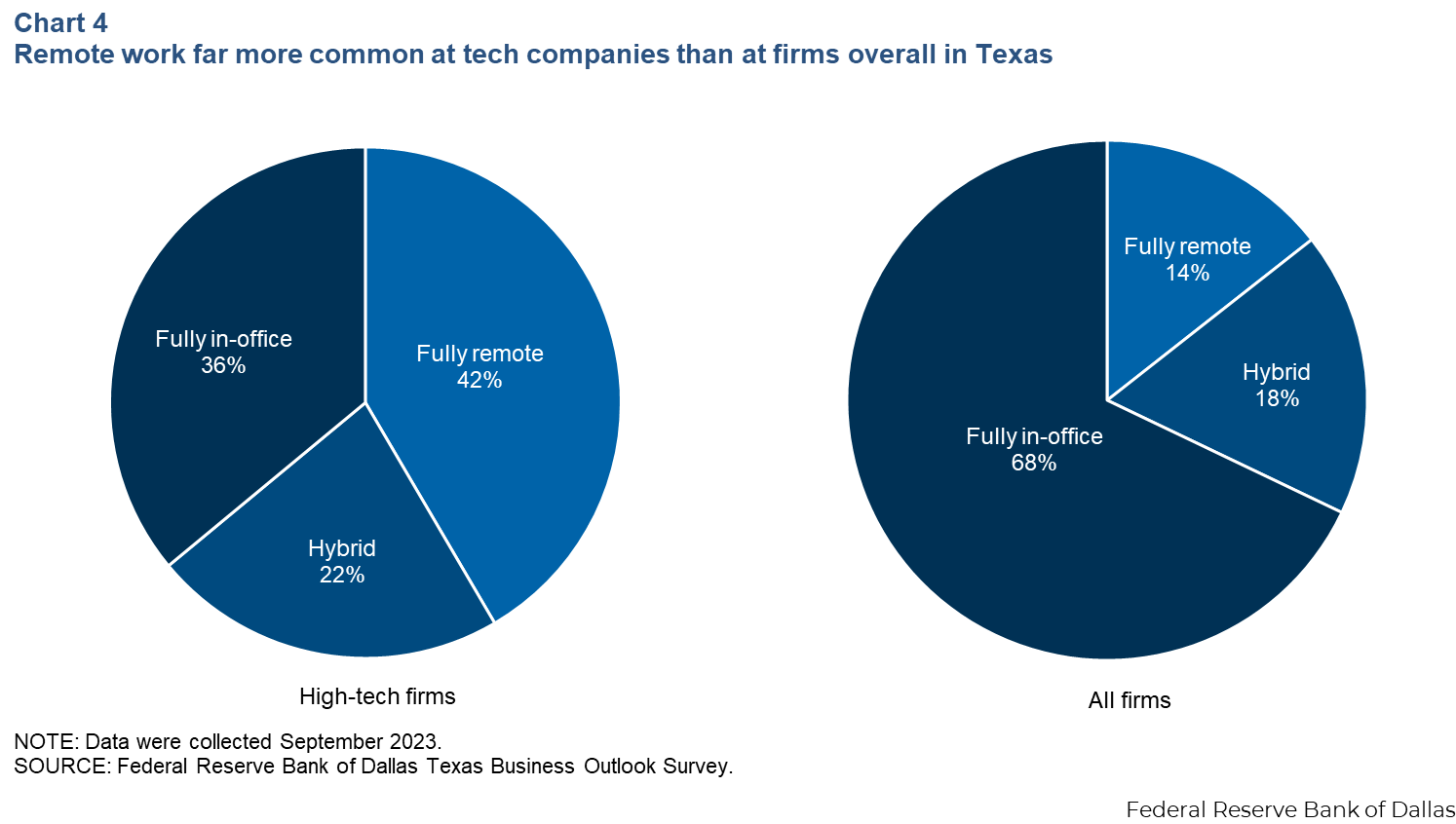
High-tech wages in Texas are significantly higher than the state average, with 2022 hourly wages averaging $43.51 compared to $29.26 for workers overall. The sector employs a larger share of highly skilled workers, supporting elevated pay. The prevalence of remote work in high tech is notable, with 36% of employees working fully remote, compared to 14% in other sectors. For trends in remote work, refer to the Harvard Business Review.
Looking ahead, high-tech firms in Texas are optimistic about future growth, buoyed by continued investments and policy support for emerging technologies like AI and semiconductor production. This optimism could be a precursor to further expansion in the sector.
More Articles
Getting licensed or staying ahead in your career can be a journey—but it doesn’t have to be overwhelming. Grab your favorite coffee or tea, take a moment to relax, and browse through our articles. Whether you’re just starting out or renewing your expertise, we’ve got tips, insights, and advice to keep you moving forward. Here’s to your success—one sip and one step at a time!
Four of the largest Multiple Listing Services (MLSs) in the Southeast have recently formed an alliance, establishing a data sharing network aimed at increasing referral business among real estate agents. The Charleston Regional MLS in South Carolina, Canopy MLS in North Carolina, Georgia MLS, and Realtracs, the largest MLS in Alabama, Kentucky, and Tennessee, have come together to create the Southeast MLS Alliance. This strategic partnership will enable members of these four MLSs to access over 85,000 listings across Alabama, Georgia, Kentucky, North Carolina, Tennessee, and South Carolina, providing real estate agents with valuable data and expanding their referral opportunities throughout the Southeast.
The current state of the mortgage market has presented prospective homebuyers with a significant challenge – surging mortgage rates. These rates have reached a 20-year high, hovering around 7.7%, making it increasingly difficult for borrowers to secure affordable loans. As a result, borrowers are actively seeking support from their family members to overcome this hurdle. To combat the impact of surging mortgage rates, borrowers are turning to their parents for financial assistance. This can take the form of gifted funds or by having parents become non-occupant co-borrowers. By involving family members in the mortgage process, borrowers can increase their chances of securing loans and achieving their homeownership goals.
In a surprising turn of events, Inga Dow, a prominent Keller Williams franchisee and CEO of multiple Texas-based Keller Williams offices, has withdrawn her sexual misconduct lawsuit against the real estate giant. While Dow's claims against Keller Williams and its co-founder, Gary Keller, have been dropped, the lawsuit against former CEO John Davis remains ongoing. The outcome of this legal battle is still uncertain, and further details may emerge as the case progresses. Stay informed with Cameron Academy's online courses tailored to your needs and goals in the real estate industry.
The recent approval of Remote Online Notarization (RON) legislation in California is a significant development that Cameron Academy is thrilled to discuss. This progressive bill, signed into law by Governor Gavin Newsom, enables individuals to notarize their documents remotely using advanced audiovisual technology. The introduction of RON legislation in California brings about numerous advantages that revolutionize the notarization process. By embracing digital advancements, California is empowering individuals and businesses with enhanced convenience and accessibility, significant time and cost savings, improved security, and streamlined workflow.
"Even though mortgage origination volumes are down, we’re experiencing a highly competitive purchase market. That means a number of businesses, seeking to grow their revenue, will likely look to expand their reach to the default and REO space. However, venturing into this industry without proper knowledge and preparation can lead to serious consequences. By understanding the lessons learned from the past foreclosure wave and staying current with the changing environment, businesses can navigate the challenges and seize the opportunities presented by the default and REO market."
In the ongoing legal battle involving the National Association of Realtors (NAR), Keller Williams, and HomeServices of America, a recent development has emerged. The plaintiffs in the lawsuit, known as the Sitzer/Burnett plaintiffs, have filed a notice to withdraw three named plaintiffs. This move is seen by the defendants as an attempt to avoid cross-examination. The lawsuit, initially filed in April 2019, challenges NAR's Participation Rule, which requires listing agents to offer compensation to buyers' agents in order to list a property on a Realtor-affiliated multiple listing service (MLS). The plaintiffs argue that this commission sharing inflates costs for consumers, in violation of the Sherman Antitrust Act. With the trial scheduled to start on October 16, the potential damages in this suit are estimated to be up to $4 billion.