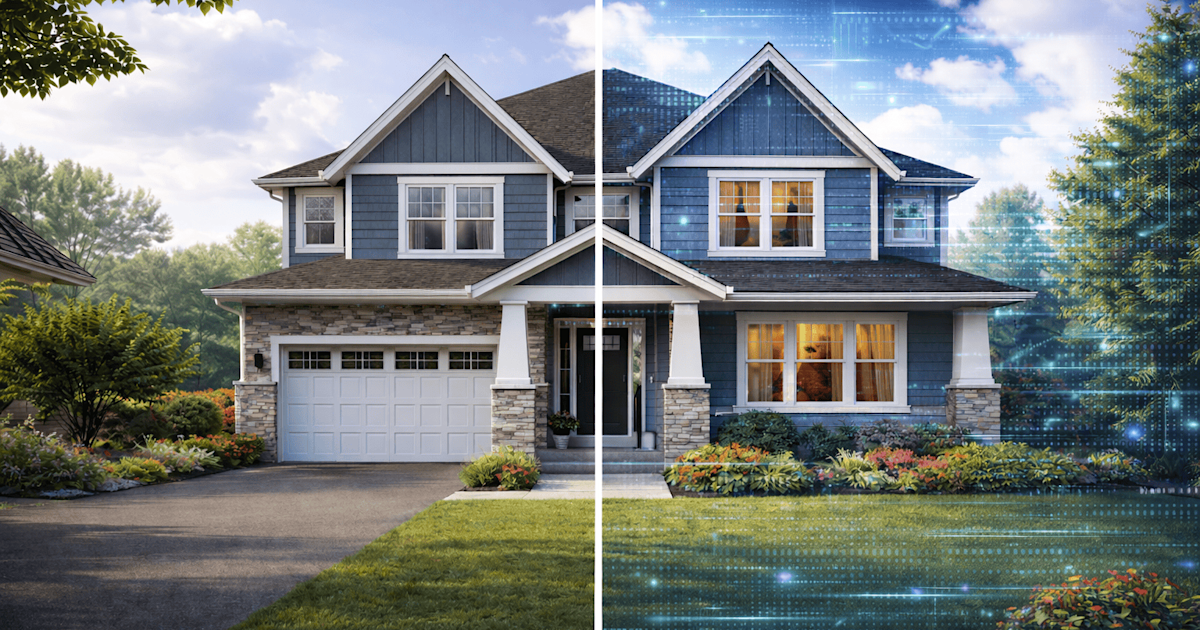
The AI Honeymoon in Real Estate Is Officially Over
After years of excitement and experimentation, the residential real estate industry is waking up to a new reality: AI isn’t a novelty anymore — it’s the infrastructure running quietly beneath nearly everything agents create and consumers see. But with that evolution comes growing tension around trust, authenticity, and what it really means to be a licensed professional in an AI‑saturated world.
AI Is Everywhere — And That’s the Problem
Agents today rely on generative AI for nearly everything: listing descriptions, social posts, email campaigns, photo enhancements, even full property presentations. What was once a powerful add‑on has become the expectation.
This explosion of content has introduced a notorious new term inside real estate circles: AI slop — repetitive, uncanny, overly polished material that all starts to look the same.
Pritesh Damani, CTO of The Real Brokerage, doesn’t see it as a downside.
“I don’t consider it slop — I consider it better content.”
To Damani, the volume is the point. Scale matters more than originality, and AI brings scale the way machinery transformed the industrial revolution.
Authenticity Takes Center Stage
But not everyone is convinced that more content means better outcomes. Holly Mabery, Chief Brokerage Officer at eXp Realty, compares the AI surge to the infamous Milli Vanilli lip‑sync scandal — polished on the surface, but potentially hollow underneath.
“What is real and what is not? At the core of everything, it has to be you.”
Mabery’s concern isn’t about productivity — it’s about trust. If an agent’s voice, visuals, and persona are AI‑generated, consumers may start doubting the human expertise they’re paying for. In response, eXp has already added AI disclosure clauses to its listing agreements and has begun training agents to properly identify what’s real and what’s virtually enhanced.
When AI Crosses Into Legal Territory
AI‑generated marketing is one thing. AI‑generated legal guidance is another.
Consumer Policy Center research fellow Wendy Gilch warns that consumers are increasingly turning to AI for guidance on contracts, negotiations, inspections, and even underwriting decisions — areas that can carry enormous financial risk if handled incorrectly.
“If you’re blindly using it to make big decisions, that’s really dangerous.”
Because real estate law varies dramatically across states, incorrectly interpreted AI advice could lead to costly outcomes — and that risk is growing fast.
The New Question: What Are Agents Being Paid For?
With AI drafting CMAs, generating pricing suggestions, writing marketing, and filtering leads, consumers may begin asking a difficult question: “If AI is doing the work, why are agents earning full commissions?”
Gilch believes the industry must address this perception now — before consumers and regulators force the conversation.
How Professionals Can Stay Ahead — And Why Education Matters
The rapid rise of AI doesn’t diminish the value of licensed professionals — it multiplies the importance of training, ethics, and clear communication. Real estate agents, mortgage professionals, insurance advisors, and others must articulate what AI does and what only a qualified human can provide.
This is exactly why professional schools like Cameron Academy are experiencing a rise in students seeking continuing education. As technology evolves, staying licensed isn’t enough — staying informed is essential.
Cameron Academy’s mission is to prepare professionals not just to pass exams, but to excel in a rapidly shifting industry landscape. AI is rewriting the rules — and education is the key to staying ahead of them.
Looking to stay competitive as AI transforms the market?
Visit
CameronAcademy.com to explore real estate, mortgage, insurance, and professional development courses built for today’s tech‑driven world.