Universal Licensing Reciprocity: A Pathway to Growth
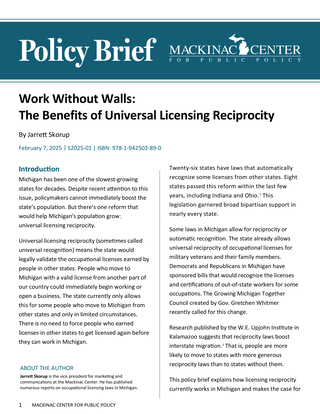
In a compelling exploration by the Mackinac Center for Public Policy, the report titled “Work Without Walls” sheds light on the transformative potential of universal licensing reciprocity. This concept, which is gaining traction across the United States, could be a key to unlocking economic growth and population expansion in Michigan.
Universal licensing reciprocity allows states to recognize occupational licenses issued in other states. This means individuals relocating to Michigan would be able to start working or open a business without the cumbersome process of obtaining a new license. The Mackinac Center’s article emphasizes the potential benefits of such a policy, particularly in addressing Michigan’s slow population growth and economic challenges.
According to the report, 26 states have already adopted various forms of universal licensing reciprocity, with eight states implementing these reforms in recent years. This movement has received bipartisan support, highlighting its appeal across political lines. The article references research from the W.E. Upjohn Institute, which indicates that states with generous reciprocity laws experience increased interstate migration, a crucial factor for Michigan’s growth.
Current Licensing Landscape in Michigan
Michigan’s current licensing framework presents significant hurdles. The state licenses approximately 180 occupations, imposing various requirements such as educational credentials, training, and fees. These regulations, while intended to protect public health and safety, often serve as barriers to employment and economic activity. The Mackinac Center argues that these laws do not significantly enhance public safety and instead limit market competition, leading to higher consumer prices.
The Case for Reform
The Mackinac Center’s article highlights the inconsistency and arbitrariness of Michigan’s licensing laws. For instance, while some occupations benefit from reciprocity agreements, others require additional schooling, exams, and fees. The article suggests that adopting a universal licensing reciprocity law would streamline this process, allowing skilled professionals to contribute to Michigan’s economy more efficiently.
A Real-World Example
The article shares the story of Anne Davis, a psychotherapist who faced significant challenges transferring her license to Michigan. Despite her extensive experience, Anne spent over a year navigating the state’s licensing requirements. This delay not only affected her livelihood but also deprived Michigan residents of a valuable service. Such examples underscore the need for reform.
Conclusion: A Call to Action
The Mackinac Center’s report concludes with a call for Michigan to join the ranks of states embracing universal licensing reciprocity. By doing so, Michigan could become one of the most accessible states for professionals seeking to relocate and contribute to the local economy. This reform would not only boost economic growth but also address workforce shortages and lower consumer prices.
For further details, you can read the full article on the Mackinac Center’s website.
More Articles
Getting licensed or staying ahead in your career can be a journey—but it doesn’t have to be overwhelming. Grab your favorite coffee or tea, take a moment to relax, and browse through our articles. Whether you’re just starting out or renewing your expertise, we’ve got tips, insights, and advice to keep you moving forward. Here’s to your success—one sip and one step at a time!
Tokenization has surged from crypto niche to global financial disruptor as institutions like Robinhood, BlackRock, and Coinbase race to digitize real-world assets. With pro‑crypto political momentum, shifting regulations, and private companies resisting newfound transparency, this emerging wave is transforming how investments are bought, sold, and accessed. For professionals in real estate, finance, lending, and insurance, this shift signals massive opportunity—and equally massive responsibility—as the next era of asset ownership takes shape.
Florida homeowners are finally getting relief as Citizens Property Insurance announces an average 8.7% statewide rate reduction for 2026, with South Florida seeing cuts as high as 14%. Driven by recent tort reforms and a stabilizing market, these decreases signal a major turnaround for an industry once on the brink of collapse — and a potential boost for real estate activity across the state.
After years of roller‑coaster chaos, the 2026 U.S. housing market is easing into something professionals haven’t seen in a long time: balance. Inventory growth has slowed to just 10% year over year—down sharply from 2025’s surge—signaling the end of the pandemic‑era scarcity and the rise of a market driven by real‑time demand and interest rates. With seasonal patterns returning, negotiations replacing bidding wars and rates drifting toward 6%, agents, lenders and investors are finally navigating conditions that look… normal.
More than half of Gen Z investors say they entered the stock market because of social media—not textbooks, not advisors. Viral creators, AI tools, and crypto trends are reshaping how young adults learn about money, invest early, and chase financial freedom. This Fortune‑featured shift highlights a generation determined to build wealth fast, trust digital voices over traditional institutions, and redefine financial education for the future.
After years of extremes, the U.S. housing market is shifting into a more balanced, predictable phase. Inventory growth has cooled from last year’s surge, seasonality is returning, and pricing is becoming increasingly rate‑sensitive. With mortgage rates hovering near 6% and policy changes reshaping investor participation, 2026 is emerging as a negotiation‑driven market where skilled agents, lenders, builders, and investors have a renewed advantage. This new landscape rewards strategy, education, and real‑time demand awareness—making it an ideal moment for professionals to refine their approach and capitalize on the market’s normalization.
A sudden policy shift at the start of 2026 is already pushing mortgage rates lower, dipping them under 6% for the first time in months. New projections suggest the government-sponsored enterprises’ $200 billion in mortgage‑backed securities purchases could accelerate rate declines throughout the year, boosting affordability, home sales, and overall market activity for buyers, sellers, and real estate professionals alike.