Why Lower Rates Aren’t Saving Commercial Real Estate (Yet)

Commercial real estate finance

The Federal Reserve has begun cutting interest rates again—something commercial real estate investors hoped would finally bring relief after years of upward pressure. Yet instead of creating momentum, the market remains frozen. Deals stall. Refinancing panic grows. And long-term borrowing costs refuse to follow the Fed’s lead.

For investors across Florida and the nation—especially those sharpening their expertise through institutions like Cameron Academy—understanding this disconnect is critical for navigating the months ahead.

Short-Term Rates Are Falling. Long-Term Rates Aren’t.

The Fed cut its benchmark rate to 3.75%–4.00% in October 2025. Traditionally, that should unlock cheaper borrowing. But the 10-year Treasury yield—the anchor for commercial mortgages—has hovered around 4.1% and recently ticked upward.

Why it matters:
Commercial mortgages follow long-term Treasuries, not the Fed funds rate. So even when the Fed cuts, persistent inflation fears keep long-term yields—and mortgage rates—stubbornly elevated.

Today’s commercial mortgages often sit 200–300 basis points above Treasuries, turning what once seemed “exceptionally high” into the industry’s uncomfortable new standard.

The Math That Broke the Market

A retail property that thrived in 2021 at a 5% cap rate with 65% leverage and 3% debt becomes nearly impossible to finance today when that same debt now demands 7%.

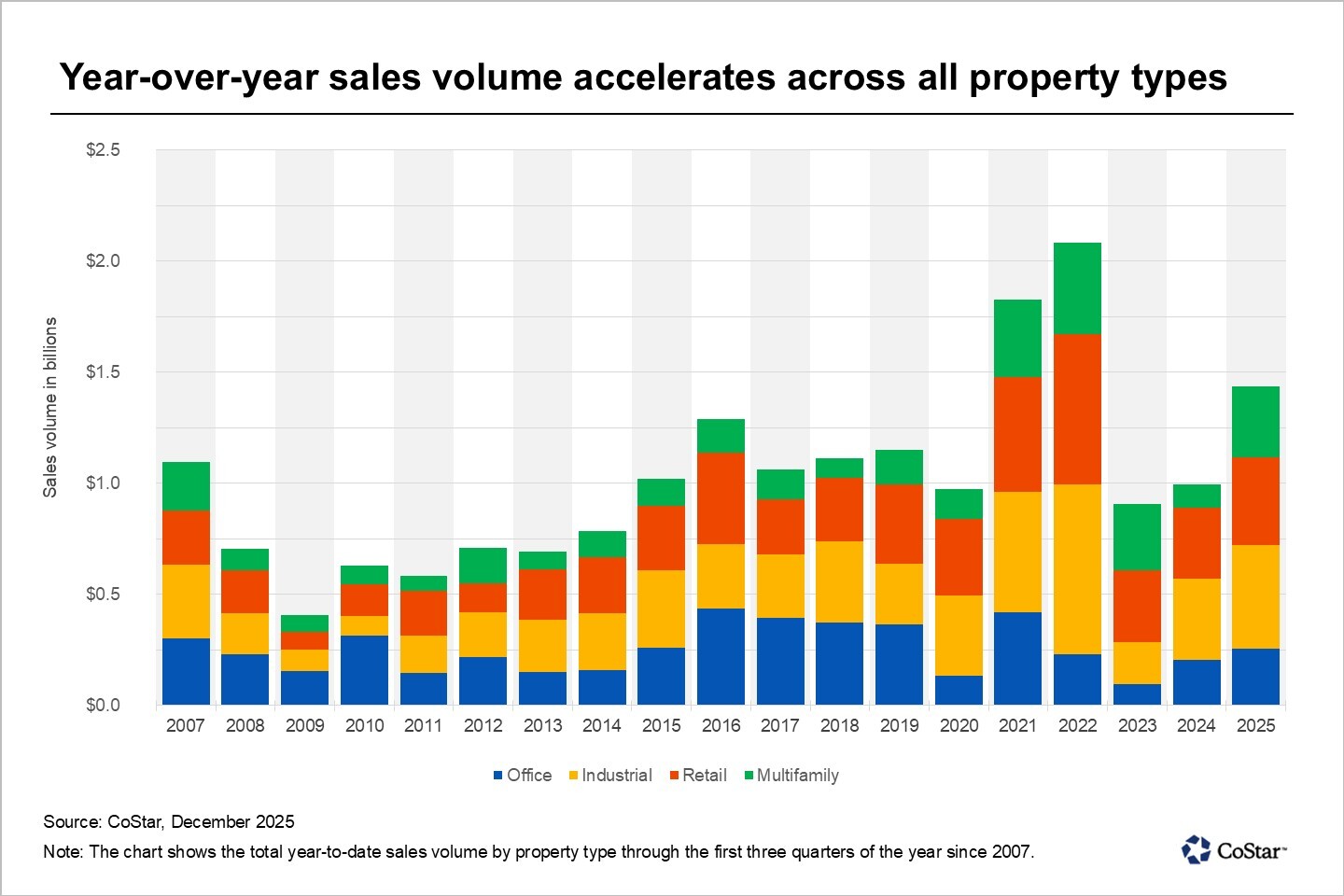
Sellers cling to yesterday’s valuations. Buyers underwrite today’s reality. The result? A national transaction slowdown that refuses to budge.

The Trillion-Dollar Refinancing Wave

Nearly $1 trillion in commercial loans will mature soon—many written during the unusually low-rate era of 2020–2021.

A $50M loan at 3% costs $1.5M per year in interest. At 7%, that cost rockets to $3.5M—an annual increase that many properties simply cannot absorb.

The consequence:
Borrowers must inject equity, sell at a loss, or default. While office assets get the most headlines, this challenge extends across property types where income growth hasn’t kept pace with rates.

Where Smart Investors See Opportunity

This environment isn’t just stressful—it’s a strategic opening. Well-capitalized investors are watching for owners who can’t refinance, paving the way for acquisitions at realistic prices or offering rescue capital at premium terms.

Private credit funds are already stepping in, frequently earning 10%+ on junior debt.

A New Era of Return Expectations

Investors accustomed to double-digit levered returns during cheap-debt years are adjusting their expectations. Today, an 8% return on a stable asset may be far more attractive when viewed through a risk-adjusted lens.

Operational strength—not financial engineering—is becoming the true differentiator.

Positioning for What’s Next

The coming year won’t be defined by rapid deal-making, but by preparation. The refinancing wave will create opportunities slowly—and the most disciplined investors will capture the best ones.

• Underwrite using today’s rates, not tomorrow’s hopes
• Prioritize strong day-one cash flow
• Focus on fundamentals over speculation
• Stay ready to pounce when distressed assets emerge

Bottom Line

Rate cuts alone can’t rescue commercial real estate while long-term yields remain elevated. But for investors who understand these dynamics, the next several quarters may reveal the most attractive buying conditions in years.

For professionals expanding their expertise—whether in real estate, mortgage, insurance, finance, or beyond—staying ahead of market shifts is essential. Educational partners like Cameron Academy help ensure you’re not just licensed, but fully prepared for the evolving landscape.

Source: WealthManagement.com

More Articles

Getting licensed or staying ahead in your career can be a journey—but it doesn’t have to be overwhelming. Grab your favorite coffee or tea, take a moment to relax, and browse through our articles. Whether you’re just starting out or renewing your expertise, we’ve got tips, insights, and advice to keep you moving forward. Here’s to your success—one sip and one step at a time!

How AI Is Transforming Financial Advisors’ Daily Routines in 2026

In 2026, financial advisors are no longer just experimenting with AI — they’re relying on it. Once confined to back-office duties, AI now supports meeting prep, portfolio analysis, and even early-stage financial planning. Advisors say the tech is strengthening client relationships by freeing them from administrative overload, though entry-level roles like paraplanners may feel the squeeze as automation accelerates.

AI Is Outpacing the Mortgage Industry’s Cyber Defenses as Attacks Surge

Cybercriminals are weaponizing AI to launch highly convincing email scams and system breaches across the mortgage industry, overwhelming lenders and servicers whose cybersecurity measures can’t keep up. With major companies already hit and regulation lagging behind, experts warn the sector—now considered critical infrastructure—must rapidly upgrade protections, collaborate on threat intelligence, and improve AI governance before the risks escalate further.

Hidden Housing Costs May Become 2026’s Most Dangerous Budget Buster

Escrow payments are quietly surging across the country as property taxes and insurance premiums spike—pushing many homeowners toward delinquencies and even foreclosure. New data from Cotality shows the sharpest increases hitting the South and Midwest, with Florida among the hardest‑hit states. Even with fixed mortgage rates, rising escrow requirements are driving monthly payments higher and threatening affordability heading into 2026.

Milwaukee’s Commercial Real Estate Market Is Turning the Corner

Milwaukee entered 2025 with renewed momentum, posting its strongest commercial real estate sales volume in three years. After a period of uncertainty and high capital costs, investors are returning with a sharper focus on quality assets, realistic pricing, and reliable cash flow. Activity is increasing across industrial, office, multifamily, and retail sectors, signaling a broad-based recovery fueled by stabilizing interest rates and improved market confidence.

Title Insurance Leaders Lean Into Tech, Efficiency, and Resilience for 2026

As 2026 approaches, the title insurance industry is navigating a complex mix of market recovery, rising fraud threats, and sweeping regulatory changes. Industry leaders say the path forward centers on smarter technology, leaner operations, and stronger support for title agents. With AI-driven workflows, enhanced fraud prevention, and new compliance demands—including FinCEN’s expanded Geographic Targeting Orders—companies like Stewart and First American are reshaping how title work gets done. For real estate and mortgage professionals, the year ahead promises more automation, heightened standards, and major opportunities for those who stay ahead of the curve.

Technology and the Future of Real Estate: Innovation Reshaping 2025

The real estate industry is undergoing a major transformation in 2025 as advancements in AI, proptech, blockchain, and data intelligence redefine how properties are marketed, valued, financed, and experienced. From instant digital valuations and immersive virtual tours to tokenized investments and predictive analytics, technology is reshaping every stage of the real estate lifecycle. Professionals who embrace these innovations—while maintaining the human expertise clients still rely on—will lead the next era of the industry.