Why Lower Rates Aren’t Saving Commercial Real Estate (Yet)

Commercial real estate finance

The Federal Reserve has begun cutting interest rates again—something commercial real estate investors hoped would finally bring relief after years of upward pressure. Yet instead of creating momentum, the market remains frozen. Deals stall. Refinancing panic grows. And long-term borrowing costs refuse to follow the Fed’s lead.

For investors across Florida and the nation—especially those sharpening their expertise through institutions like Cameron Academy—understanding this disconnect is critical for navigating the months ahead.

Short-Term Rates Are Falling. Long-Term Rates Aren’t.

The Fed cut its benchmark rate to 3.75%–4.00% in October 2025. Traditionally, that should unlock cheaper borrowing. But the 10-year Treasury yield—the anchor for commercial mortgages—has hovered around 4.1% and recently ticked upward.

Why it matters:
Commercial mortgages follow long-term Treasuries, not the Fed funds rate. So even when the Fed cuts, persistent inflation fears keep long-term yields—and mortgage rates—stubbornly elevated.

Today’s commercial mortgages often sit 200–300 basis points above Treasuries, turning what once seemed “exceptionally high” into the industry’s uncomfortable new standard.

The Math That Broke the Market

A retail property that thrived in 2021 at a 5% cap rate with 65% leverage and 3% debt becomes nearly impossible to finance today when that same debt now demands 7%.

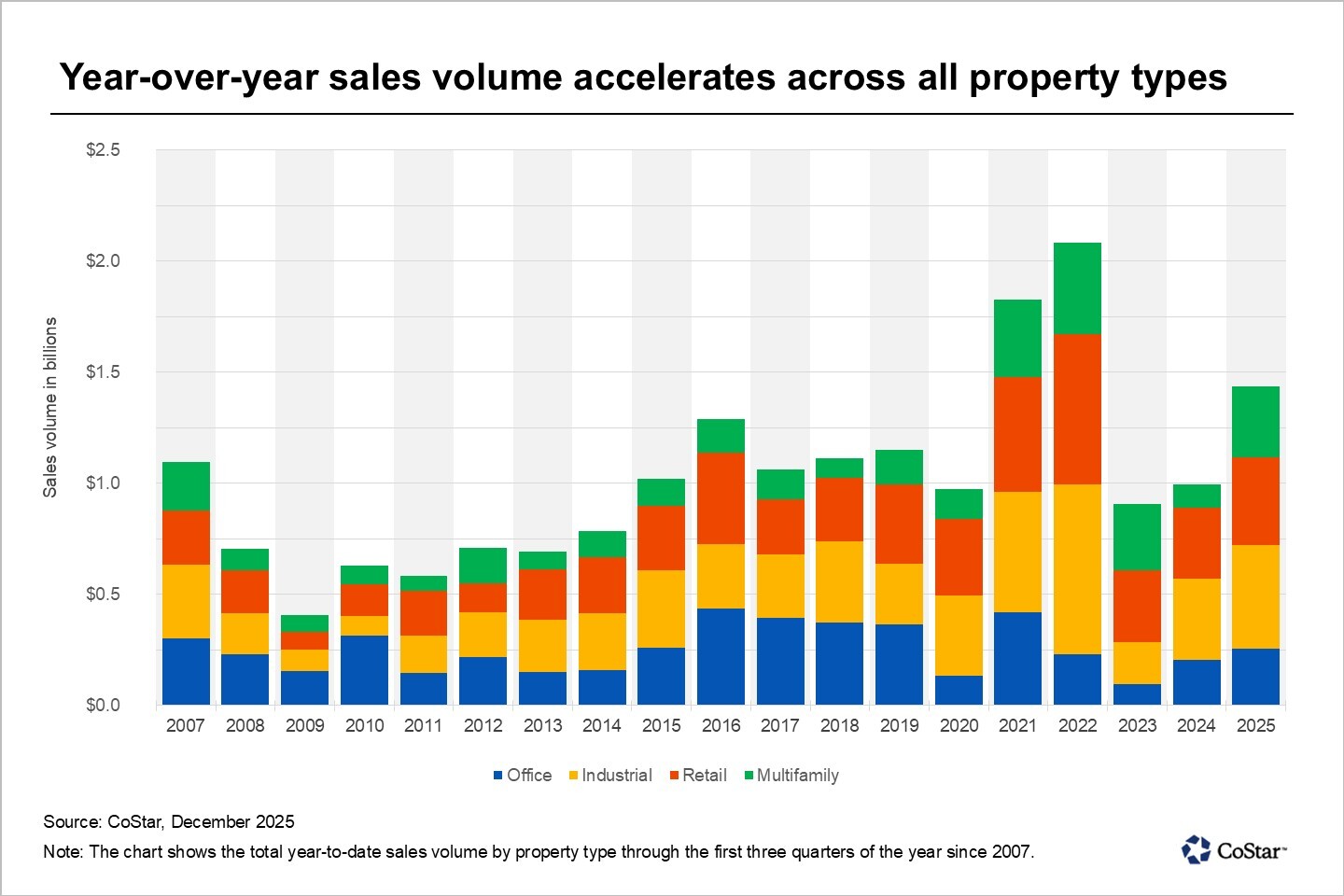
Sellers cling to yesterday’s valuations. Buyers underwrite today’s reality. The result? A national transaction slowdown that refuses to budge.

The Trillion-Dollar Refinancing Wave

Nearly $1 trillion in commercial loans will mature soon—many written during the unusually low-rate era of 2020–2021.

A $50M loan at 3% costs $1.5M per year in interest. At 7%, that cost rockets to $3.5M—an annual increase that many properties simply cannot absorb.

The consequence:
Borrowers must inject equity, sell at a loss, or default. While office assets get the most headlines, this challenge extends across property types where income growth hasn’t kept pace with rates.

Where Smart Investors See Opportunity

This environment isn’t just stressful—it’s a strategic opening. Well-capitalized investors are watching for owners who can’t refinance, paving the way for acquisitions at realistic prices or offering rescue capital at premium terms.

Private credit funds are already stepping in, frequently earning 10%+ on junior debt.

A New Era of Return Expectations

Investors accustomed to double-digit levered returns during cheap-debt years are adjusting their expectations. Today, an 8% return on a stable asset may be far more attractive when viewed through a risk-adjusted lens.

Operational strength—not financial engineering—is becoming the true differentiator.

Positioning for What’s Next

The coming year won’t be defined by rapid deal-making, but by preparation. The refinancing wave will create opportunities slowly—and the most disciplined investors will capture the best ones.

• Underwrite using today’s rates, not tomorrow’s hopes
• Prioritize strong day-one cash flow
• Focus on fundamentals over speculation
• Stay ready to pounce when distressed assets emerge

Bottom Line

Rate cuts alone can’t rescue commercial real estate while long-term yields remain elevated. But for investors who understand these dynamics, the next several quarters may reveal the most attractive buying conditions in years.

For professionals expanding their expertise—whether in real estate, mortgage, insurance, finance, or beyond—staying ahead of market shifts is essential. Educational partners like Cameron Academy help ensure you’re not just licensed, but fully prepared for the evolving landscape.

Source: WealthManagement.com

More Articles

Getting licensed or staying ahead in your career can be a journey—but it doesn’t have to be overwhelming. Grab your favorite coffee or tea, take a moment to relax, and browse through our articles. Whether you’re just starting out or renewing your expertise, we’ve got tips, insights, and advice to keep you moving forward. Here’s to your success—one sip and one step at a time!

The Mortgage Industry’s AI Transformation: Automation Reshapes Lending From Application to Approval

Artificial intelligence is rapidly reshaping the mortgage industry, boosting productivity, reducing manual work, and accelerating loan closings. From automated document data extraction to AI‑generated underwriting narratives and predictive analytics, lenders are using new tools that improve accuracy and drastically speed up processing times. With chatbots, next‑gen point‑of‑sale systems, and end‑to‑end automation, preapprovals that once took days now take minutes. For mortgage and real estate professionals, mastering AI is becoming a major competitive advantage—one that defines who will thrive in the future of lending.

Why Your Insurance Bill Is Rising Even as Florida Rates Go Down

Florida’s property insurance rates are finally starting to drop, but many homeowners are still seeing higher monthly bills. The reason isn’t insurer price hikes—it’s soaring replacement costs driven by construction inflation, labor shortages, and rising home values. Nearly 75 percent of recent premium increases came from higher property values alone. Understanding this gap between “rates” and “premiums” helps homeowners—and real estate and insurance professionals—navigate the shifting Florida market and make smarter coverage decisions.

Milwaukee’s Commercial Real Estate Market Turns a Corner

Milwaukee’s commercial real estate market is finally showing real signs of recovery, with 2025 sales volume hitting a three‑year high and investor confidence steadily returning. Driven by selective, fundamentals‑focused buying—favoring strong cash flow, quality assets, and strategic pricing—the city is moving from a period of correction into a healthier, opportunity‑rich phase. For real estate professionals nationwide, Milwaukee’s momentum reflects broader CRE market stabilization and the growing importance of disciplined underwriting and market expertise.

Reverse Mortgage Market Poised for Breakout Growth in 2026

Industry leaders project a major surge in reverse mortgage activity heading into 2026, fueled by rising proprietary products, lender innovation, and strong investor interest. As high interest rates push originators to adopt new strategies, flexible private‑label options, senior‑focused HELOCs, and a wave of big‑capital investment are reshaping the market. With education and policy shifts poised to unlock even more demand, reverse mortgages are entering their most transformative era yet.

The 2026 Housing Market Outlook: Is Better Inventory Finally on the Horizon?

Experts forecast that 2026 may bring long‑awaited relief to homebuyers, with both existing and new home inventory expected to rise. NAR predicts a boost in home sales, a slight drop in mortgage rates, and a modest 4% increase in prices—conditions that could motivate more homeowners to list while builders add over a million new homes to the market. For first‑time buyers, higher loan limits and easing qualification standards may make entering the market more achievable than in recent years.

Lower Interest Rates Signal a Brighter 2026 for South Florida Real Estate

South Florida enters 2026 with renewed optimism as falling mortgage rates, improving buyer confidence, and a strong job market help stabilize a housing landscape that struggled in 2025—especially in the condo sector. While single-family homes remained resilient last year, condos faced price drops, rising fees, and hesitation tied to new safety regulations. With rates projected to fall to around 5.8% by year’s end, buying power is increasing, inventory may loosen, and activity is expected to pick up. Still, affordability challenges persist, Miami’s rental market remains intensely competitive, and the condo sector’s recovery will take time.