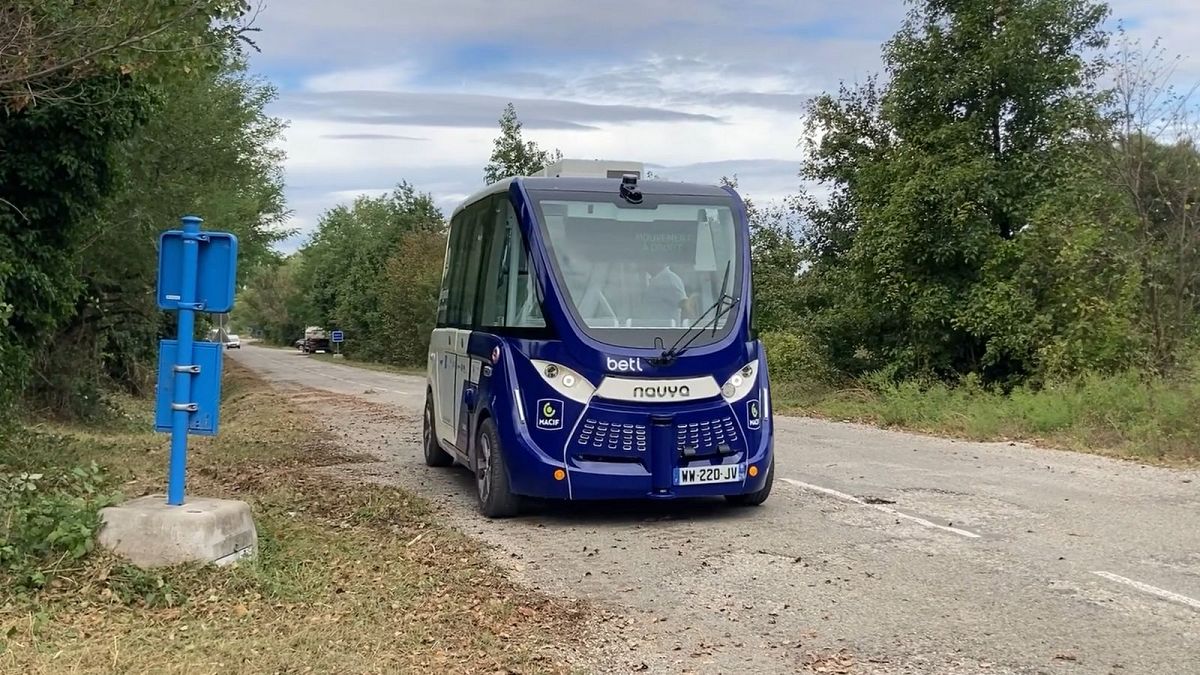
Driverless Shuttles: A New Era of Mobility in Rural France
In the picturesque yet sparsely populated region of Val de Drôme – Crest in southeastern France, a quiet revolution is underway. The deployment of self-driving shuttles is transforming the way residents navigate their rural surroundings. This initiative, launched in 2020, is part of a broader European effort to harness automated electric vehicles (EVs) as a viable public transport solution in areas where traditional services are often lacking.
Yann Arnaud, director of responses to customer needs and innovation at the French insurance company MACIF, emphasized the potential of these shuttles during a conversation with Euronews. “We are trying to ensure that this is a new means of travel and mobility for people living in suburban or rural areas,” he stated, highlighting the project’s aim to reduce isolation and improve accessibility.
Technology and Safety
The shuttles operate on a predefined 5 km route, making seven stops over a 20-minute journey. A control operator oversees the operation to ensure safety. Benjamin Beaudet, general director at Beti, the operator of the automated shuttles, explained that the technology aligns with the European vision for automated vehicles. The shuttles “learn” their routes and compare real-time observations with pre-learned data to navigate safely.
In contrast to American and Chinese companies like Waymo, Uber, and Tesla, which focus on self-driving taxis with flexible routes, the European approach prioritizes defined paths, enhancing safety and predictability.
Addressing Rural Needs
The introduction of these shuttles in Val de Drôme – Crest, where the population density is significantly lower than the national average, has been met with positive feedback. Residents appreciate the newfound mobility options, especially in areas where alternatives are limited. Arnaud noted, “The question of acceptability arises when you have the luxury of having other options. When you don’t have a choice, you’re very happy to have [the shuttle].”
This sentiment underscores the potential of driverless vehicles to address mobility challenges in rural areas, particularly for the elderly and those without access to personal transportation.
Challenges and Future Prospects
Despite the promising start, scaling these projects to permanent services remains a challenge. High costs, logistical hurdles, and technological requirements, as outlined in an Open Research Europe article, pose significant barriers. The EU has invested €159 million in research and innovation related to automated mobility since 2021, yet achieving commercial viability continues to be elusive.
The success of initiatives like AVENUE and SHOW, which have conducted pilot projects across Europe, including in Crest, offers hope. However, transitioning from pilot programs to sustainable, everyday solutions requires overcoming substantial obstacles.
As Europe continues to explore the potential of automated vehicles, the experiences in rural France provide valuable insights into the future of mobility. With continued innovation and investment, driverless shuttles could become a cornerstone of public transport in remote areas, offering a greener, more accessible alternative to traditional car use.
More Articles
Getting licensed or staying ahead in your career can be a journey—but it doesn’t have to be overwhelming. Grab your favorite coffee or tea, take a moment to relax, and browse through our articles. Whether you’re just starting out or renewing your expertise, we’ve got tips, insights, and advice to keep you moving forward. Here’s to your success—one sip and one step at a time!
Four of the largest Multiple Listing Services (MLSs) in the Southeast have recently formed an alliance, establishing a data sharing network aimed at increasing referral business among real estate agents. The Charleston Regional MLS in South Carolina, Canopy MLS in North Carolina, Georgia MLS, and Realtracs, the largest MLS in Alabama, Kentucky, and Tennessee, have come together to create the Southeast MLS Alliance. This strategic partnership will enable members of these four MLSs to access over 85,000 listings across Alabama, Georgia, Kentucky, North Carolina, Tennessee, and South Carolina, providing real estate agents with valuable data and expanding their referral opportunities throughout the Southeast.
The current state of the mortgage market has presented prospective homebuyers with a significant challenge – surging mortgage rates. These rates have reached a 20-year high, hovering around 7.7%, making it increasingly difficult for borrowers to secure affordable loans. As a result, borrowers are actively seeking support from their family members to overcome this hurdle. To combat the impact of surging mortgage rates, borrowers are turning to their parents for financial assistance. This can take the form of gifted funds or by having parents become non-occupant co-borrowers. By involving family members in the mortgage process, borrowers can increase their chances of securing loans and achieving their homeownership goals.
In a surprising turn of events, Inga Dow, a prominent Keller Williams franchisee and CEO of multiple Texas-based Keller Williams offices, has withdrawn her sexual misconduct lawsuit against the real estate giant. While Dow's claims against Keller Williams and its co-founder, Gary Keller, have been dropped, the lawsuit against former CEO John Davis remains ongoing. The outcome of this legal battle is still uncertain, and further details may emerge as the case progresses. Stay informed with Cameron Academy's online courses tailored to your needs and goals in the real estate industry.
The recent approval of Remote Online Notarization (RON) legislation in California is a significant development that Cameron Academy is thrilled to discuss. This progressive bill, signed into law by Governor Gavin Newsom, enables individuals to notarize their documents remotely using advanced audiovisual technology. The introduction of RON legislation in California brings about numerous advantages that revolutionize the notarization process. By embracing digital advancements, California is empowering individuals and businesses with enhanced convenience and accessibility, significant time and cost savings, improved security, and streamlined workflow.
"Even though mortgage origination volumes are down, we’re experiencing a highly competitive purchase market. That means a number of businesses, seeking to grow their revenue, will likely look to expand their reach to the default and REO space. However, venturing into this industry without proper knowledge and preparation can lead to serious consequences. By understanding the lessons learned from the past foreclosure wave and staying current with the changing environment, businesses can navigate the challenges and seize the opportunities presented by the default and REO market."
In the ongoing legal battle involving the National Association of Realtors (NAR), Keller Williams, and HomeServices of America, a recent development has emerged. The plaintiffs in the lawsuit, known as the Sitzer/Burnett plaintiffs, have filed a notice to withdraw three named plaintiffs. This move is seen by the defendants as an attempt to avoid cross-examination. The lawsuit, initially filed in April 2019, challenges NAR's Participation Rule, which requires listing agents to offer compensation to buyers' agents in order to list a property on a Realtor-affiliated multiple listing service (MLS). The plaintiffs argue that this commission sharing inflates costs for consumers, in violation of the Sherman Antitrust Act. With the trial scheduled to start on October 16, the potential damages in this suit are estimated to be up to $4 billion.