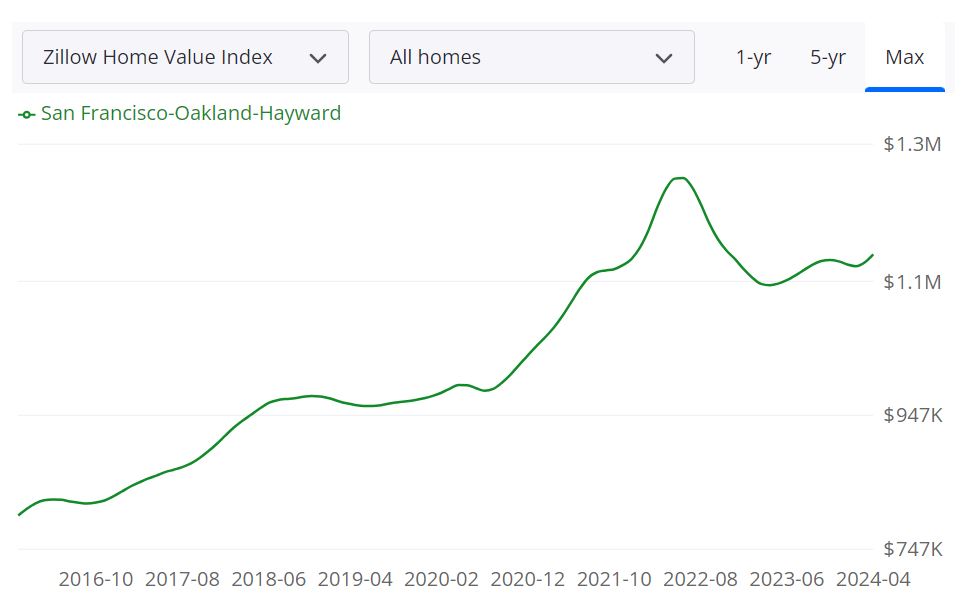
The Bay Area housing market, renowned for its competitive nature and soaring prices, continues to evolve, leaving both buyers and sellers eager for insights to navigate its complexities. This dynamic market, centered around San Francisco, Oakland, and San Jose, remains a focal point due to its unique blend of economic strength, cultural vibrancy, and desirable living conditions.
Market Predictions and Trends
The Bay Area housing market in 2024 is projected to unfold in one of three scenarios, each influenced by various economic factors:
Moderate Price Correction: Rising interest rates and economic uncertainties could lead to a slight decline in prices, providing some relief to buyers without triggering a market crash.
Stagnant Growth: Strong demand, coupled with housing shortages, might stabilize prices, offering no significant advantage to either buyers or sellers.
Continued Growth: Despite economic challenges, the limited housing supply and high desirability may sustain price increases, though at a slower pace.
Key indicators like inventory levels, days on the market, and sales volume will be crucial in forecasting the market’s trajectory.
Reasons for High Prices
Several factors contribute to the Bay Area’s steep housing costs:
Strong Economy: As a global tech hub, the region attracts high-income professionals, fueling demand.
Limited Supply: Geographical constraints and strict zoning laws hinder new construction efforts.
High Land Costs and Foreign Investment: Expensive land and international buyers drive prices upward.
Desirability and Limited Growth Space: The area’s quality of life and restricted space for expansion add to the price pressures.
Hottest Markets and Investment Opportunities
Currently, the suburb of Woodlands in Walnut Creek is experiencing a market surge thanks to its suburban appeal and proximity to job centers. Other areas like Oakland in the East Bay and Fremont in the South Bay are also attracting significant interest from buyers.
For investors, the Bay Area’s enduring demand, diverse locations, and robust rental market present lucrative opportunities. However, challenges such as high property prices and complex regulations require careful market analysis. The region offers a range of real estate investment options, from residential and multi-unit properties to commercial real estate and short-term rentals.
The Bay Area’s robust economy, heavily driven by the tech sector, continues to promise growth. Despite supply shortages and zoning restrictions, the region remains a potentially rewarding arena for real estate investments, as detailed in the original article from Norada Real Estate Investments.
More Articles
Getting licensed or staying ahead in your career can be a journey—but it doesn’t have to be overwhelming. Grab your favorite coffee or tea, take a moment to relax, and browse through our articles. Whether you’re just starting out or renewing your expertise, we’ve got tips, insights, and advice to keep you moving forward. Here’s to your success—one sip and one step at a time!
November marked another cooldown for commercial real estate, with total deal volume dropping 10% year over year and falling below even 2020’s levels. While overall activity is slowing, investors are concentrating their money on bigger, more resilient assets—driving a 51% surge in deals over $100 million and pushing average transaction sizes well above historical norms. Multifamily remains the strongest sector, office deals are becoming more strategically focused, and medical office and data centers continue to outperform as long‑term demand stays solid.
After years of stalled activity, commercial real estate may finally be nearing a rebound. Experts say that expected interest‑rate drops in 2026 could reignite investor confidence, unlock sidelined capital, and boost deal flow across multiple sectors. But the outlook isn’t uniformly sunny—multifamily faces oversupply, industrial is cooling after years of rapid growth, and weakening employment conditions may slow absorption. For professionals across real estate, mortgage, insurance, and finance, the shifting landscape presents both challenges and major opportunities for those who stay informed and properly licensed.
Consumer Reports delivered a major warning to Congress, highlighting how rapidly expanding fintech tools—especially AI‑driven platforms—are outpacing consumer protections. In testimony before the House Subcommittee on Digital Assets, Financial Technology and AI, CR called for stronger, clearer rules to prevent hidden fees, predatory practices, and confusion within digital financial products. For professionals in real estate, mortgages, insurance, and finance, these emerging regulations may soon influence lending decisions, underwriting, credit evaluations, and compliance expectations across the industry.
Amazon is preparing to cut up to 30,000 corporate jobs by mid‑2026 as it pivots aggressively toward automation and AI. Following 14,000 layoffs in late 2025, the company is eliminating layers of management to redirect billions into robotics, generative AI systems, and supercomputing partnerships. While warehouse hiring continues for seasonal demand, Amazon’s internal shift reveals a broader nationwide trend: white‑collar roles across tech, finance, logistics, and more are being reshaped by automation at unprecedented speed.
Florida’s real estate market enters 2026 with new leadership at the helm as Chuck Bonfiglio, broker-owner of AAA Realty Group, is officially installed as President of Florida Realtors. With more than 230,000 members behind the association, Bonfiglio highlights affordability, insurance reform, and taxes as key priorities while expressing optimism about easing mortgage rates, stabilizing prices, and growing inventory. Backed by years of statewide and national Realtor leadership, he aims to guide professionals through another transformative year alongside a newly appointed 2026 leadership team.
Tampa isn’t cooling off—it’s getting smarter. After years of rapid expansion, the city’s commercial real estate market has shifted into a more disciplined, selective phase. Population growth remains strong, office leasing is outperforming national trends, industrial activity is normalizing sustainably, and retail is seeing renewed investor confidence. With capital becoming more cautious and health care real estate emerging as a major growth sector, Tampa is entering a new era focused on strategy, execution, and long‑term fundamentals.