The Bay Area housing market, renowned for its competitive nature and soaring prices, continues to evolve, leaving both buyers and sellers eager for insights to navigate its complexities. This dynamic market, centered around San Francisco, Oakland, and San Jose, remains a focal point due to its unique blend of economic strength, cultural vibrancy, and desirable living conditions.
Market Predictions and Trends
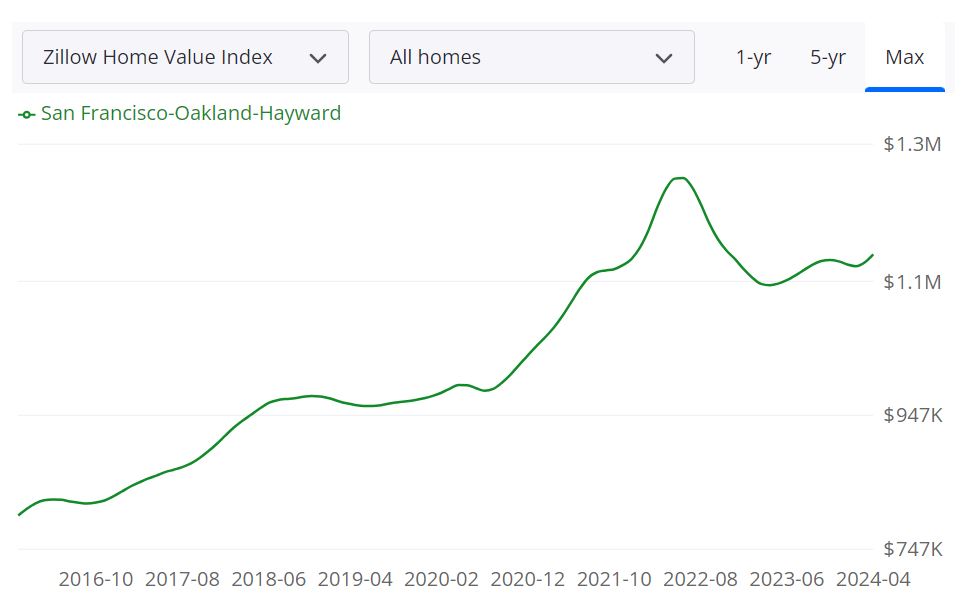
The Bay Area housing market in 2024 is projected to unfold in one of three scenarios, each influenced by various economic factors:
Moderate Price Correction: Rising interest rates and economic uncertainties could lead to a slight decline in prices, providing some relief to buyers without triggering a market crash.
Stagnant Growth: Strong demand, coupled with housing shortages, might stabilize prices, offering no significant advantage to either buyers or sellers.
Continued Growth: Despite economic challenges, the limited housing supply and high desirability may sustain price increases, though at a slower pace.
Key indicators like inventory levels, days on the market, and sales volume will be crucial in forecasting the market’s trajectory.
Reasons for High Prices
Several factors contribute to the Bay Area’s steep housing costs:
Strong Economy: As a global tech hub, the region attracts high-income professionals, fueling demand.
Limited Supply: Geographical constraints and strict zoning laws hinder new construction efforts.
High Land Costs and Foreign Investment: Expensive land and international buyers drive prices upward.
Desirability and Limited Growth Space: The area’s quality of life and restricted space for expansion add to the price pressures.
Hottest Markets and Investment Opportunities
Currently, the suburb of Woodlands in Walnut Creek is experiencing a market surge thanks to its suburban appeal and proximity to job centers. Other areas like Oakland in the East Bay and Fremont in the South Bay are also attracting significant interest from buyers.
For investors, the Bay Area’s enduring demand, diverse locations, and robust rental market present lucrative opportunities. However, challenges such as high property prices and complex regulations require careful market analysis. The region offers a range of real estate investment options, from residential and multi-unit properties to commercial real estate and short-term rentals.
The Bay Area’s robust economy, heavily driven by the tech sector, continues to promise growth. Despite supply shortages and zoning restrictions, the region remains a potentially rewarding arena for real estate investments, as detailed in the original article from Norada Real Estate Investments.
More Articles
Getting licensed or staying ahead in your career can be a journey—but it doesn’t have to be overwhelming. Grab your favorite coffee or tea, take a moment to relax, and browse through our articles. Whether you’re just starting out or renewing your expertise, we’ve got tips, insights, and advice to keep you moving forward. Here’s to your success—one sip and one step at a time!
After years of soaring premiums and insurer instability, Florida’s property insurance market is finally turning a corner. Major carriers have filed 83 requests for rate decreases heading into 2026, with companies like Florida Peninsula and Patriot Select proposing cuts of 8.4% and 11.3%. Some homeowners may see relief as early as next month, signaling a long‑awaited shift toward market stability.
Fix-and-flip investing is gearing up for one of its strongest years in a decade as 2026 approaches. With cheaper capital, more accessible funding, easing interest rates, and long-awaited increases in housing inventory, investors are finding the perfect environment to launch or scale renovation-based real estate businesses. Renovation continues to outpace new construction in cost and speed, and demand for move-in-ready homes remains high, making 2026 a powerful opportunity window for both new and experienced investors.
After a short-lived period of relief in 2025, the U.S. rental market may be headed for a tighter, more expensive 2026. With construction starts dropping nearly 11% and completions plunging 42%, the surge of new apartments that helped lower rents is rapidly drying up. Rising costs, shrinking inventory, and a slowdown in new development point to a potential rental crunch that could leave renters facing heavier competition and higher prices across major markets next year.
The commercial real estate market is entering a rare reset that experts say mirrors the post‑2008 boom, creating a potential window for disciplined investors. With trillions in commercial debt coming due and property values dropping up to 40%, firms like AARE are positioning themselves to acquire assets below replacement cost—an advantage that could set the stage for significant long‑term growth.
Commercial real estate is entering a reinvention phase, with AI‑driven productivity, modernized office demand, experience‑focused retail, expanding industrial logistics, creative housing solutions, and sustainability‑centered design all accelerating nationwide. These six forces are shaping how investors, brokers, and future licensees will operate in a rapidly evolving U.S. market.
After years of economic uncertainty and cautious decision‑making, 2026 is shaping up to be the year professionals finally catch a break. AI is moving from buzzword to essential tool, capital markets are beginning to thaw, and hiring is picking up across real estate, mortgage, insurance, finance, and healthcare. With opportunity returning, many professionals are using this moment to upskill—pursuing new licenses, certifications, and cross‑industry expertise.