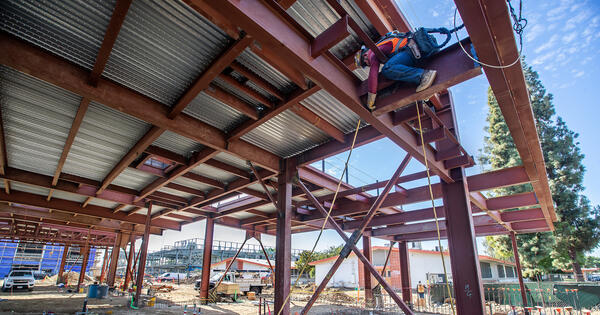
As families consider relocating, the quality of local public schools often becomes a pivotal factor. The allure of modern athletic facilities, spacious classrooms, and cutting-edge technology in science and computer labs can be irresistible for parents who equate these attributes with a superior education. But, as a recent study from Yale Insights explores, does the financial investment in school infrastructure genuinely enhance educational outcomes?
Barbara Biasi, an Assistant Professor of Economics at Yale SOM, alongside her colleagues Julien Lafortune and David Schönholzer, delved into this question. Their research, which spans data from across the United States, seeks to unravel the complex relationship between capital spending on schools and its impact on educational quality and real estate prices. For those interested in a deeper dive, the full article can be found here.
The study’s findings indicate that while capital projects generally increase both test scores and property values, the benefits are predominantly seen in districts with disadvantaged students. Interestingly, the type of capital project plays a crucial role in determining its impact. Projects focused on infrastructure improvements, such as HVAC systems, significantly enhance test scores but do not necessarily raise property values. Conversely, investments in visible amenities like athletic facilities tend to boost property prices.
Biasi’s research highlights a critical consideration for voters who decide on capital proposals. She emphasizes the importance of understanding whether these investments will truly benefit students or merely serve to increase local property values. As she notes, “Public schools are supposed to be free, but really people are paying for the best public school they can afford.”
Implications for Policy and Community
This study raises essential questions about the role of voters in making decisions that impact educational infrastructure. With the majority of voters not being parents, there’s a risk that the benefits of certain projects may not be fully appreciated or prioritized. Biasi hopes that this research will encourage a more informed discussion around school funding and its implications for both students and the broader community.
Looking ahead, Biasi and her team plan to explore how different funding rules across states affect the approval and impact of capital projects. This next phase aims to provide further insights into how modifications in funding rules could potentially reshape the educational landscape.
For more insights from Barbara Biasi and her team, visit her profile on Yale Insights.
More Articles
Getting licensed or staying ahead in your career can be a journey—but it doesn’t have to be overwhelming. Grab your favorite coffee or tea, take a moment to relax, and browse through our articles. Whether you’re just starting out or renewing your expertise, we’ve got tips, insights, and advice to keep you moving forward. Here’s to your success—one sip and one step at a time!
The Western U.S. commercial real estate sector is gearing up for a pivotal year in 2026, with new forecasts from Kidder Mathews showing steady economic growth, moderating inflation, and improving fundamentals across office, industrial, retail, and multifamily markets. From slow but stabilizing office recovery to strong retail performance and tightening industrial demand, the region is entering a period of rebalancing that presents fresh opportunities for real estate and related professionals.
A delayed federal jobs report has pushed ADP’s data into the spotlight, revealing that private employers added just 22,000 jobs in January — far below expectations. Revised December numbers and ongoing declines in key sectors like professional services and manufacturing point to a cooling labor market heading into 2025. While wage growth remains steady, uneven job creation across regions and industries is raising new questions about future interest‑rate cuts and what this shifting economy means for professionals in fields like real estate, mortgage, insurance, and finance.
Nashville’s booming tech-driven population is transforming luxury real estate, making smart technology and eco‑friendly design the new standard. From AI‑powered adaptive living and advanced security systems to high‑efficiency construction and green incentives, the city’s top communities—Brentwood, Franklin, and Nolensville—are leading a movement toward intelligent, energy‑saving homes that offer long‑term value and modern comfort.
Florida legislators have confirmed that no new insurance relief is coming in 2026, leaving homeowners to grapple with rising premiums and shrinking options. While Republican leaders argue that past reforms simply need more time to stabilize the market, Democrats are pushing for immediate action as families across the state feel the financial strain. With insurance changes off the table, lawmakers are shifting their focus to property tax relief—creating important ripple effects for real estate, mortgage, and insurance professionals watching the market closely.
A new CBRE survey reveals that 2026 is shaping up to be a bullish year for commercial real estate, with most investors planning to expand their portfolios. Dallas secures the top spot for the fifth year in a row, but Southeast metros like Atlanta, Miami, Tampa, and Charlotte are rapidly gaining ground thanks to population growth, strong job creation, and resilient demand in sectors like tech, logistics, and healthcare.
Washington State University’s Carson College of Business has introduced Carson Pro, a flexible online platform offering non‑credit certificates in finance, management, marketing, accounting, and specialty fields like the business of aging and wine business management. Designed for working professionals seeking practical, career-ready skills or a complete career reset, the program reflects a nationwide shift toward continuous learning as industries—from real estate to finance—evolve at a rapid pace.